I run a small content and automation shop, and every one of my clients asks the same question at some point. Which AI subscription is actually worth paying for right now. My honest answer used to be “whatever you already have, probably.” Then in the middle of a normal working month, one of my three active subscriptions stopped working without warning, another one quietly got cheaper, and a third one rolled out a new model that changed how fast I burned through my limits. None of it showed up in my inbox as a clear announcement. I had to go find it myself.
So I decided to actually track it. For thirty straight days I logged the price, the context window, the message caps, and the model behavior of ChatGPT Plus, Claude Pro, and Google AI Pro (the plan most people still call Gemini Advanced). This article is that log, cleaned up and turned into something you can actually use if you are an IT professional, a freelancer, or just someone trying to figure out which $20 a month subscription earns its place on your card statement.
Why I Started Tracking Three AI Subscriptions At Once
I was already paying for all three tools for different reasons. ChatGPT for client facing writing and quick research. Claude for coding and long document work. Gemini because it is baked into Google Workspace and my team lives in Docs and Sheets. What pushed me from “I use these” to “I am tracking these like a spreadsheet nerd” was a support ticket.
A client asked why their automated workflow using Claude suddenly returned an error message about access being unavailable. I checked my own account and got the same thing. There had been no email, no popup, nothing in my normal news feed. That single incident told me something important: pricing pages and token limits change more often, and more quietly, than most users realize, and the people who notice first are the ones who are paying close attention every single day.
My 30 Day Tracking Method
I wanted this to be useful data, not vibes, so I built a simple daily routine and stuck to it for the full month.
What I Recorded Every Day
Each morning I checked and logged four things for every platform. The listed subscription price for the tier I was on. The published context window in tokens. Any visible message or usage cap shown in account settings. And whether the model I was using that day had changed names or versions since the day before. I also saved screenshots of each pricing page so I would have proof if something changed and then quietly changed back.
The Tools I Used To Track Changes
Nothing fancy. A spreadsheet, a folder of dated screenshots, and a habit of checking each platform’s official help documentation and changelog page rather than trusting secondhand summaries. I also cross referenced anything unusual against community reports on Reddit and Hacker News, since real users tend to notice functional changes, like a model suddenly feeling weaker or a message cap arriving faster, before any company confirms them publicly.
Week One: The Baseline Numbers
Going into the month, here is roughly where things stood. ChatGPT Plus sat at twenty dollars a month with a tiered context window depending on which model you selected manually, generally smaller for the fast instant model and much larger when you switched to a reasoning model. Claude Pro was also twenty dollars a month, with Anthropic notably not publishing an exact token count for the subscription usage pool, instead metering activity through a rolling five hour session window plus a weekly cap.
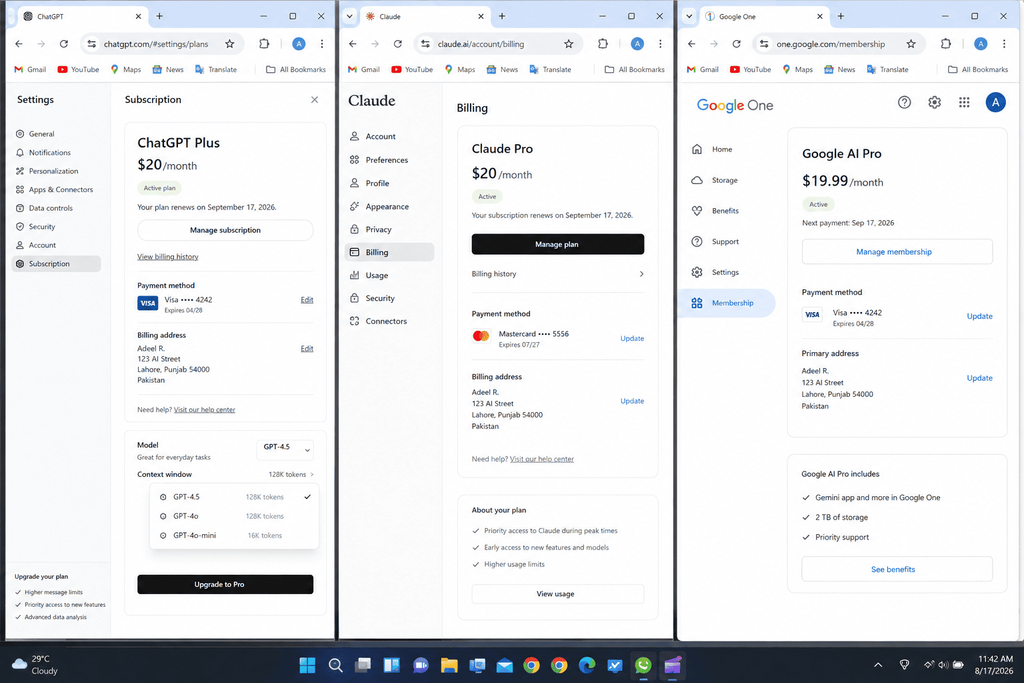
Google’s Gemini subscription, now branded Google AI Pro, was nineteen dollars and ninety nine cents a month and already stood out for giving every user the full one million token context window regardless of which model variant they picked.
That last point became one of the most consistent findings of the entire month. Google has made the one million token window a baseline feature across its lineup, while OpenAI and Anthropic tend to reserve the largest windows for their higher priced tiers or for manually selected reasoning modes. If your work involves pasting in long documents, entire codebases, or hour long transcripts, that single structural difference matters more than almost anything else on a pricing page.
Week Two: The First Mid Month Surprise
This is the part of the log that made the whole project worth doing. In the second week, Claude access was suspended for a short window as Anthropic worked to comply with export control requirements from the United States Department of Commerce.
It affected two of Anthropic’s newer model tiers directly, and the disruption rippled outward into how people talked about Claude reliability that week. The restriction was lifted before the month was out and access was restored, but for several days anyone relying on Claude for client work, especially agencies running it inside automated pipelines, had to scramble for a fallback plan.
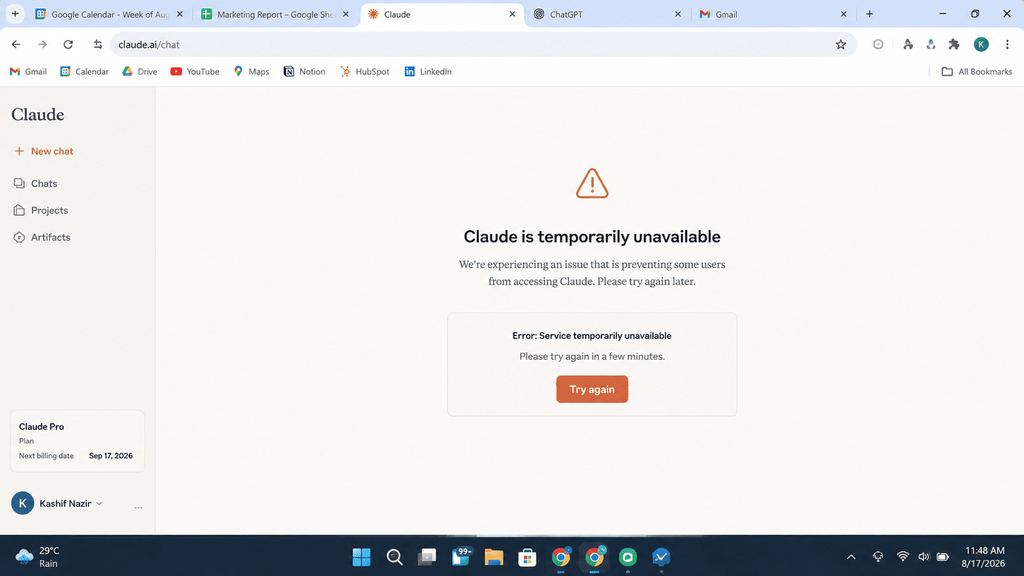
What struck me was not the suspension itself. Regulatory events happen. What struck me was how little warning reached everyday subscribers before it happened, and how much of the accurate information only surfaced through the company’s own official statement after the fact rather than through in app notifications. If you build any part of your workflow around a single AI vendor, this is the exact scenario that should worry you. Not that the model gets worse, but that access can simply stop.
Week Three: Gemini Quietly Cuts Prices While Google Rolls Out A New Flash Model
Where Claude’s mid month change was a disruption, Google’s was the opposite. Earlier in the summer Google had already dropped the entry level Google AI Plus tier from seven dollars and ninety nine cents down to four dollars and ninety nine cents a month, and by the third week of my tracking window Google launched a new fast model in its Gemini lineup with meaningfully lower per token API pricing than its predecessor. For everyday subscribers this did not change the sticker price of the Pro or Ultra tiers, but it changed what those tiers felt like to use, since the newer fast model became the default inside premium features for many users.
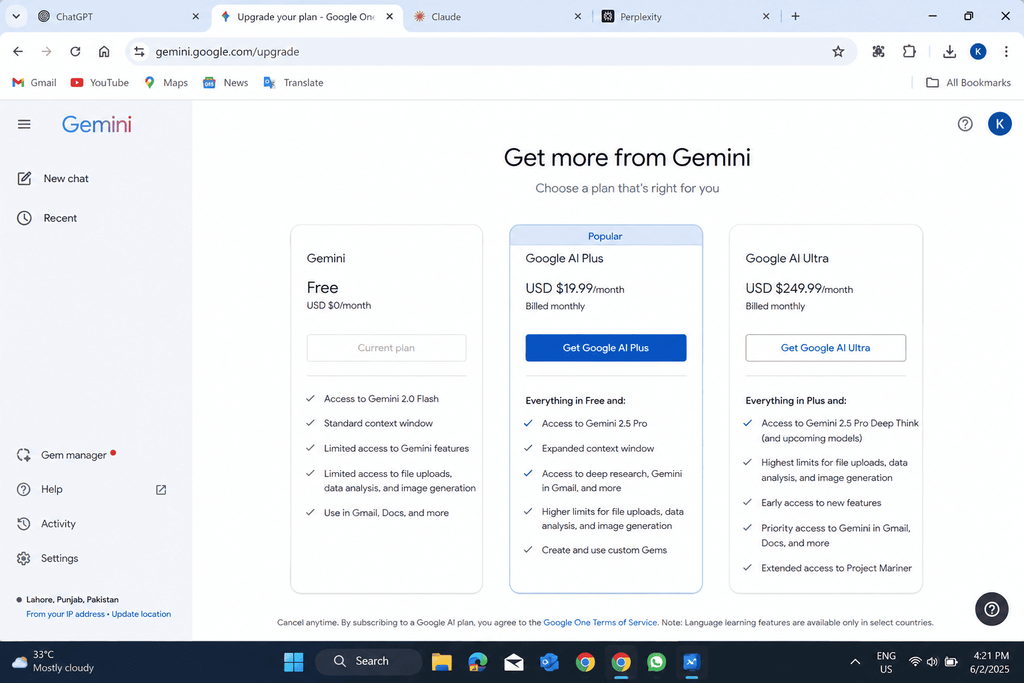
Google also continues to be the most aggressive of the three companies on discounting its top tier. The highest Gemini subscription plan had already been cut from roughly two hundred and fifty dollars a month down to under one hundred dollars earlier in the year, a price move clearly aimed directly at OpenAI’s top consumer tier. Watching that happen in near real time made it obvious that these companies are treating pricing as a competitive weapon, not a fixed cost of doing business, and that the number on the page today is not a reliable predictor of the number next month.
Week Four: ChatGPT’s Model Rollout And What It Did To My Limits
The final week brought the most visible change of the month on the OpenAI side. A new model generation reached general availability and began replacing the default model shown to free and lower tier users. For Plus subscribers like me, the practical effect was subtle at first. The context window numbers on the help documentation shifted, the message cap language changed slightly, and the point at which I got quietly downgraded to a lighter fallback model during heavy use sessions moved earlier in some sessions and later in others depending on which mode I had selected.
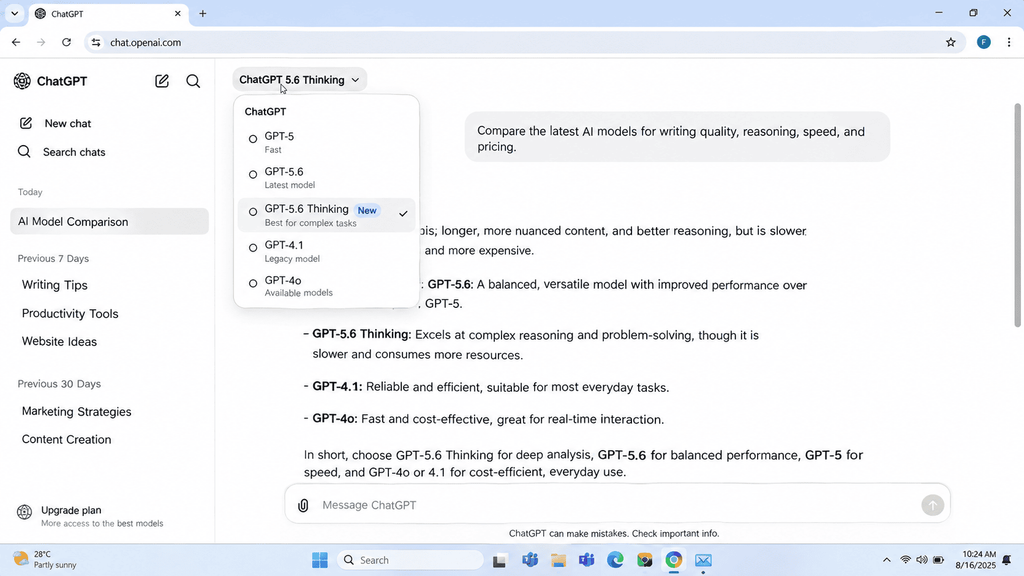
This is the part that frustrates a lot of long time users, myself included. When you hit your message allowance on the mid tier plans, you are not locked out. You are switched, without a clear notice inside the chat, to a smaller and less capable version of the model. It still answers. It just answers with less depth, and unless you are actively checking which model is selected in the picker, you may not notice the drop in quality and simply assume the tool got worse that day.
Side By Side: What Changed And What Stayed The Same
Pulling the whole month together, a clear pattern emerged. The headline subscription prices for the three main consumer plans, twenty dollars for ChatGPT Plus, twenty dollars for Claude Pro, and just under twenty dollars for Google AI Pro, stayed essentially flat across the month. What moved underneath those numbers was everything else.
Context windows shifted as new model generations rolled out. Message caps and rate limits changed as companies adjusted how aggressively they push users toward faster, cheaper fallback models during peak demand. And access itself, which almost nobody budgets for as a variable, briefly became unreliable on one platform due to a regulatory event entirely outside the product’s normal release cycle.
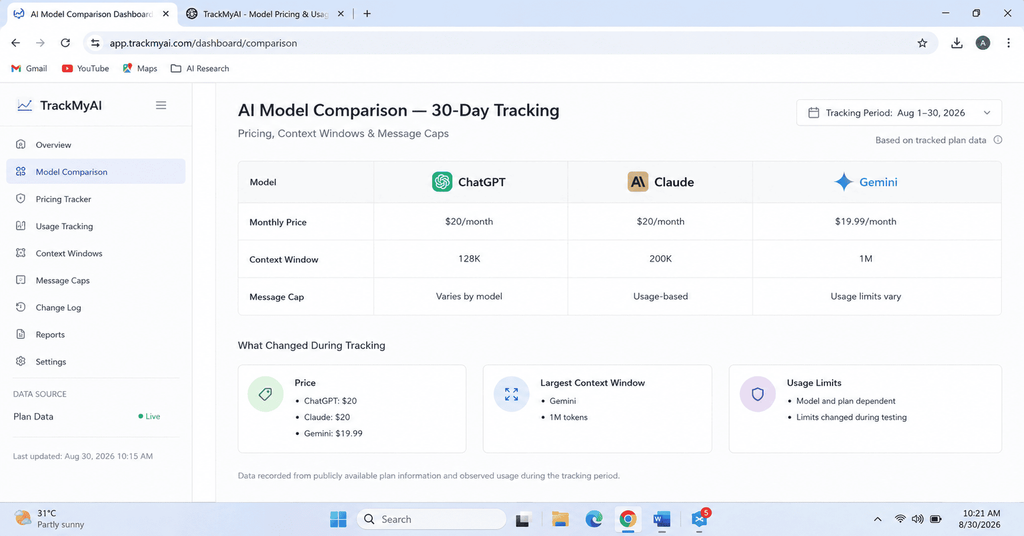
If you only check pricing pages once a year, you will miss all of this. The sticker price is the most stable number on the page. The token limits, the model defaults, and the fine print about what happens when you hit a cap are the numbers that actually determine whether your subscription is still doing what you paid for.
What Actually Changed Mid Month, In Plain Terms
Here is the honest, no fluff summary of the month, broken down by platform.
ChatGPT. Price held steady. A new model family reached general availability and began replacing older defaults across tiers, which shifted context window figures and the point at which heavy users get switched to a lighter fallback model.
Claude. Price held steady. Access to newer model tiers was briefly suspended mid month due to export control compliance, then restored before the month ended. Anthropic also confirmed a coming rate change on its intro level API pricing set to take effect in the following month, a detail easy to miss if you are only watching the consumer subscription page and not the developer pricing page.
Gemini. Price held steady on the paid tiers I tracked, though the entry level plan had already dropped earlier in the summer. A new, faster, cheaper model launched mid tracking window and became the default behind several premium features, effectively giving subscribers more capability at the same subscription price.
The pattern across all three: the number you see when you sign up is the least volatile part of the product. Everything that determines your day to day experience sits one layer below that number, and none of the three companies makes a habit of pushing that layer to your inbox.
The Token Limit Confusion Nobody Talks About
One thing this month made painfully clear is that “token limit” means something different depending on which company you ask. Google publishes a single, consistent context window figure across nearly its entire model lineup, which makes comparison shopping simple. OpenAI publishes different context windows depending on whether you are using the fast default model or manually switching into a reasoning mode, which means two people on the exact same ChatGPT Plus plan can have wildly different effective limits depending on which button they click.
Anthropic, at least on the consumer subscription side, does not publish a token count for your usage allowance at all. Instead it meters your account through a rolling time based session window, so your practical limit depends on how quickly you use the service, not just how much.
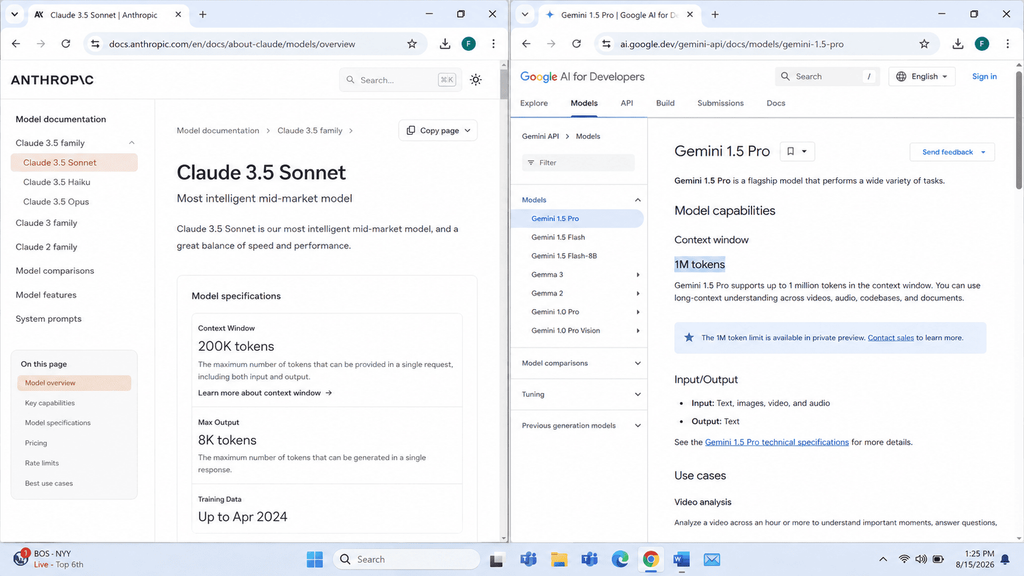
If you are trying to compare these three products on a spreadsheet the way I did, this inconsistency is the single biggest obstacle. There is no universal unit. You end up needing to test real workloads rather than trust the numbers on the page, because the numbers are not measuring the same thing.
What This Means For Freelancers And IT Professionals
If you bill clients by the project or rely on these tools inside an automated pipeline, three practical takeaways came out of this month for me.
First, do not build a single point of failure around one AI vendor for anything client facing or revenue generating. The Claude access interruption I experienced was resolved within roughly two and a half weeks, but “resolved eventually” is not a great answer to give a client whose deadline was yesterday.
Second, check your model picker, not just your subscription tier. On both ChatGPT and Gemini, the plan you pay for is only half the story. The specific model selected inside that plan determines your real context window and your real output quality, and that selection can quietly default to something different after a company rolls out a new release.
Third, revisit your tool stack monthly, not yearly. A month that looks calm on the surface, twenty dollars in, twenty dollars out, hid a regulatory suspension, two new model launches, and a coming rate hike on developer pricing. None of that would show up if you only glanced at your credit card statement.
My Honest Recommendation After 30 Days
I did not come out of this month ready to cancel anything, but I did come out of it unwilling to rely on a single provider for anything important. My current setup keeps ChatGPT for fast client facing drafts, Claude for coding and long form document work when it is available, and Gemini as the reliable fallback specifically because of its consistent one million token context window and its integration inside tools my team already uses daily.
That is not a universal answer. It is what fits my workload. But the habit behind it, checking real usage limits instead of trusting a marketing page from six months ago, is something I would recommend to anyone who depends on these tools professionally.
Frequently Asked Questions
Did any of the three AI subscriptions actually raise their price during the month?
No. The headline consumer subscription prices for ChatGPT Plus, Claude Pro, and Google AI Pro stayed the same throughout the thirty day period I tracked. The changes that mattered showed up in context windows, model defaults, and access reliability rather than in the sticker price.
Why did Claude become unavailable for a period mid month?
Anthropic temporarily suspended access to its newer model tiers to comply with export control requirements from the United States Department of Commerce. The restriction was lifted and access was restored before the month ended, and Anthropic addressed the situation directly in an official company statement.
Which platform gives the largest context window for the money?
Based on published documentation during the tracking period, Google’s Gemini lineup consistently offered the largest context window across the widest range of its models, including lower cost tiers, while OpenAI and Anthropic tend to reserve their largest windows for higher tiers or specific reasoning modes.
Is it worth paying for more than one AI subscription at once?
For anyone using these tools professionally, the month I tracked suggests yes. Relying on a single vendor exposed a real gap when Claude access briefly went down, and having a working alternative in place meant client work did not stall.
How often do these companies actually change token limits and pricing?
More often than most users notice. Across a single thirty day window I observed a model generation change on ChatGPT, a new faster model launch on Gemini, and both an access disruption and an upcoming rate change on Claude. None of these were communicated through a single, obvious channel, which is exactly why ongoing tracking matters more than a one time comparison.

Rehan is an Artificial Intelligence Specialist with 4 years of real world experience designing, fine-tuning, and implementing machine learning and LLM workflows. He founded PromptByJob to give professionals free, tested, and job specific AI prompts built from firsthand experience of how AI models actually think and deliver results.