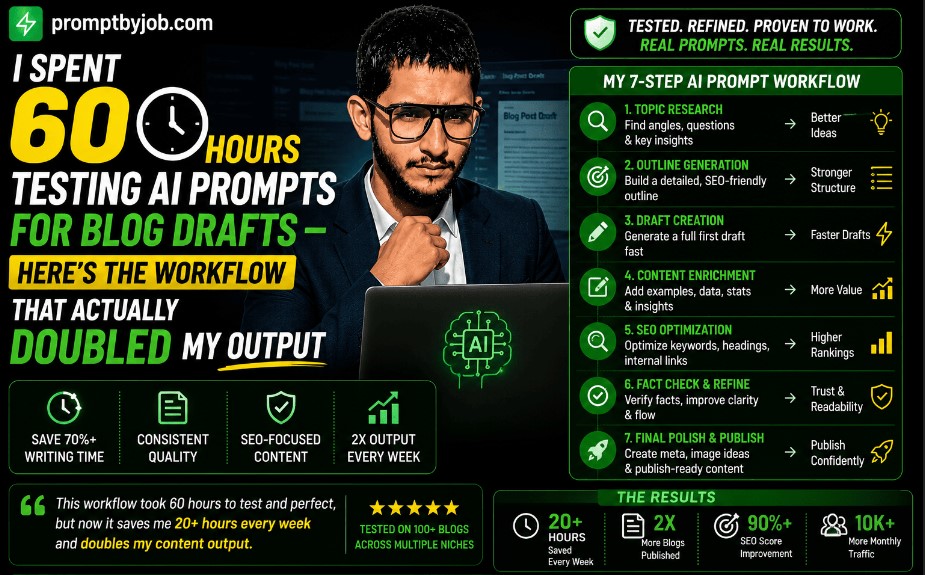
I spent thirty days testing forty different AI writing prompts to write a full month of blog content, and I am going to be honest with you about what happened. Most of what I generated did not survive contact with my editor. Some of it barely made it past the first paragraph before getting flagged as generic, hollow, or just plain boring. But a handful of prompts, maybe ten out of the forty, produced drafts that needed only light touch ups before they went live.
If you write content for a living, or you manage freelance writers, or you are a marketer trying to figure out whether AI prompts can actually replace part of your writing process, this article is for you. I am not going to give you a theoretical breakdown of prompt engineering. I am going to walk you through exactly what I tested, how my editor graded each draft, and which prompts earned a permanent spot in my workflow.
Why I Tested AI Writing Prompts In The First Place
Every content writer I talk to is asking some version of the same question right now. Can AI actually carry a chunk of the writing workload, or does it just create more editing work than it saves? I kept seeing lists online claiming to have the best AI prompts for bloggers, but almost none of them showed real before and after results. Nobody was publishing actual pass rates.
So I decided to run my own test with real stakes. I write for a niche blog that publishes four posts a week. My editor is strict about voice, accuracy, and originality, partly because Google’s recent quality updates have made thin AI generated content a liability instead of a shortcut. If a post reads like it came straight out of a chatbot with no human fingerprints on it, it gets sent back. I wanted to know exactly which prompt types could survive that kind of scrutiny and which ones would get bounced every single time.
How I Set Up The Test
I gave myself one full month, thirty days, and a target of forty prompts covering every stage of the writing process. That meant prompts for topic ideas, outlines, introductions, body sections, conclusions, meta descriptions, and even prompts meant to rewrite my own rough drafts into something tighter.
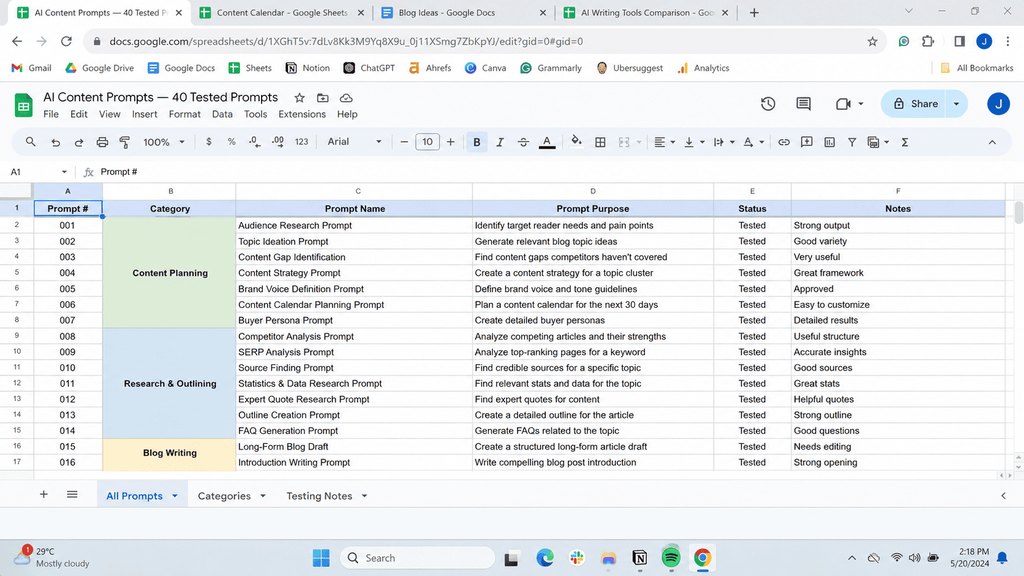
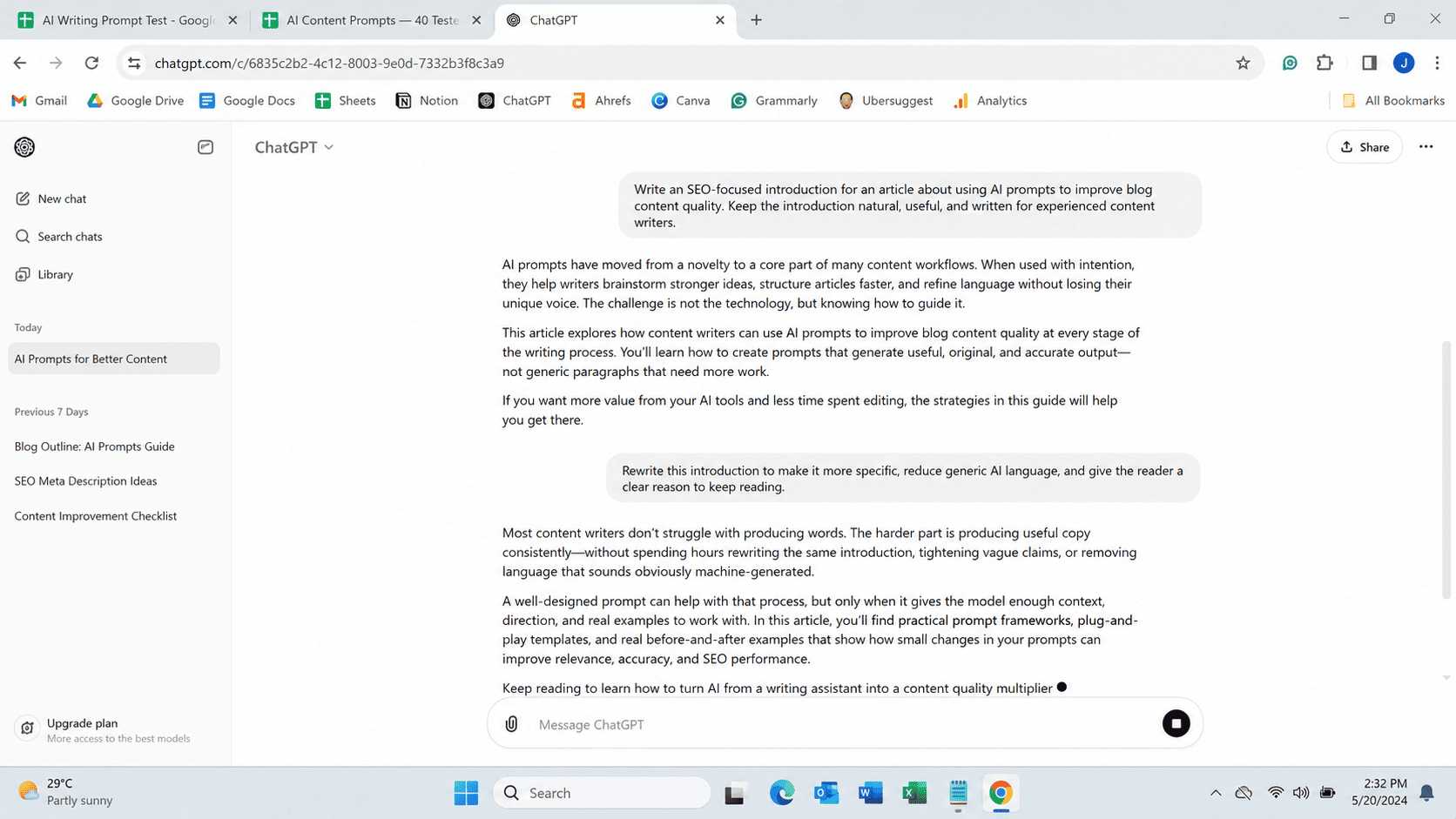
To carry out the various tasks, I employed several models: ChatGPT, Claude, and Gemini. There were no fictional prompts; I assigned real topics to every prompt and my editor reviewed the resulting drafts according to her usual standard operating procedures without any specific consideration of this project. She did not know which content was produced by the AI and what was written by my hand.
The Prompts I Used
The forty prompts fell into six rough categories.
Given the broad topic below, generate five distinct angles for a single article, not five separate topics. Each angle must take a different position: one contrarian angle that challenges common advice on this topic, one angle built around a specific failure or mistake, one angle built around a measurable result or number, one angle comparing two specific approaches, and one angle aimed at a narrow, underserved reader segment. For each angle, write one sentence explaining exactly what a reader would learn that they cannot already find in the top ranking articles on this topic. Do not produce generic angles like ultimate guide or everything you need to know.

Topic:
- Topic and angle generation prompts, the kind that ask the model to brainstorm ideas or find a fresh spin on an overused subject
- Outline and structure prompts that request a full skeleton with headings before any actual writing happens
- Full section drafting prompts that ask the model to write out a complete block of content based on a short brief
- Tone matching prompts where I fed the model a sample of my own writing and asked it to imitate the voice
- Editing and tightening prompts meant to take a messy human draft and clean it up
- SEO support prompts for meta descriptions, title variations, and internal linking suggestions
My Editor’s Pass or Fail Criteria
Before I started, I asked my editor to grade every draft using the same four checkpoints she uses for any submission, human or AI assisted.
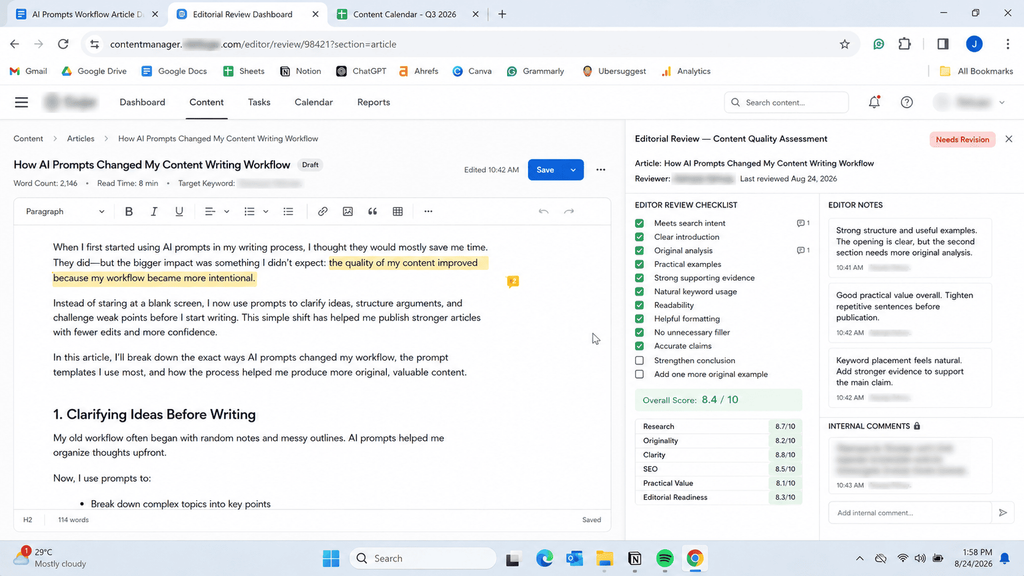
To begin with, does this piece include a precise piece of information that only someone who has direct experience in a topic can know. Subsequently, is the organization here logical or just a semblance of organization. Then, is the tone used by the writer similar to the brand name and remains the same throughout the entire text. Finally, will this text be considered original and convincing by the audience?
Anything that failed two or more of those checkpoints got rejected outright and sent back for a full rewrite.
The Results After Thirty Days
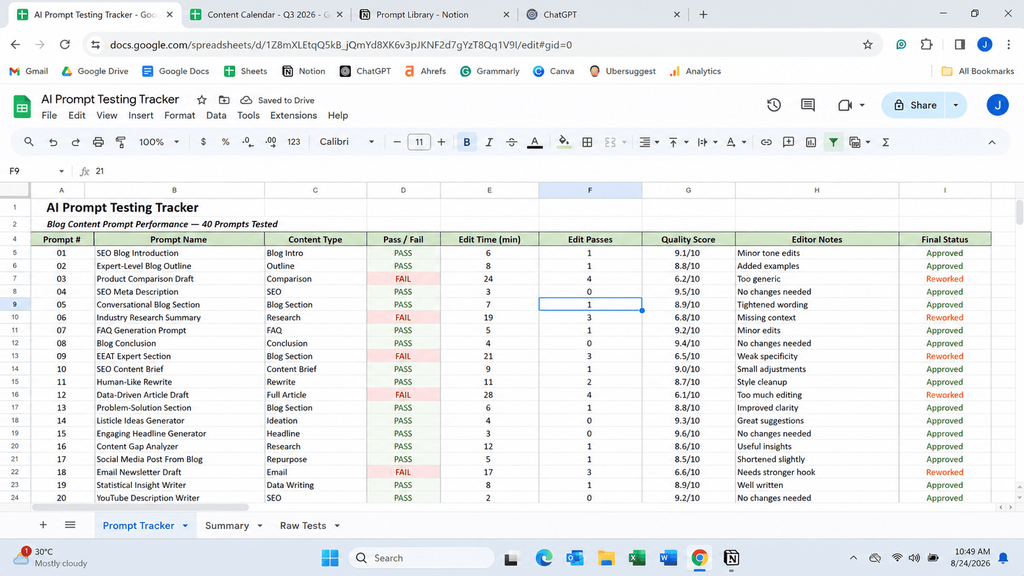
Out of the forty prompts, eleven passed on the first submission with only minor copy edits. Eighteen passed after moderate rewriting, meaning my editor kept the bones of the AI draft but rewrote large chunks by hand. Eleven failed completely and got scrapped, meaning it was faster to start over from a blank page than to fix what the prompt produced.
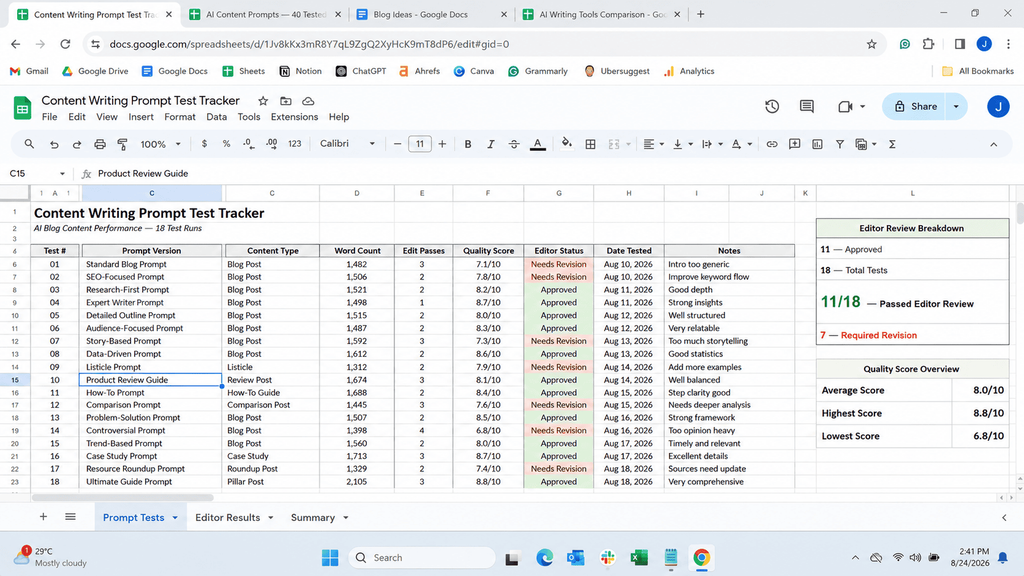
That eleven out of forty pass rate surprised me. I expected the number to be higher going in, mostly because the drafts read smoothly on a first pass. It was only when my editor dug into specifics, checking whether a claim was actually true or whether an example felt lived in, that the cracks showed up.
Prompts That Passed On The First Try
The prompts that passed cleanly almost all shared one trait. They asked the model to work from something specific I had already given it, rather than asking it to invent something from scratch. A prompt that said write an introduction about email marketing failed almost every time. A prompt that said take this paragraph of my own notes about a mistake I made in a recent email campaign and turn it into a punchy introduction, keeping the specific numbers I mentioned, passed almost every time.
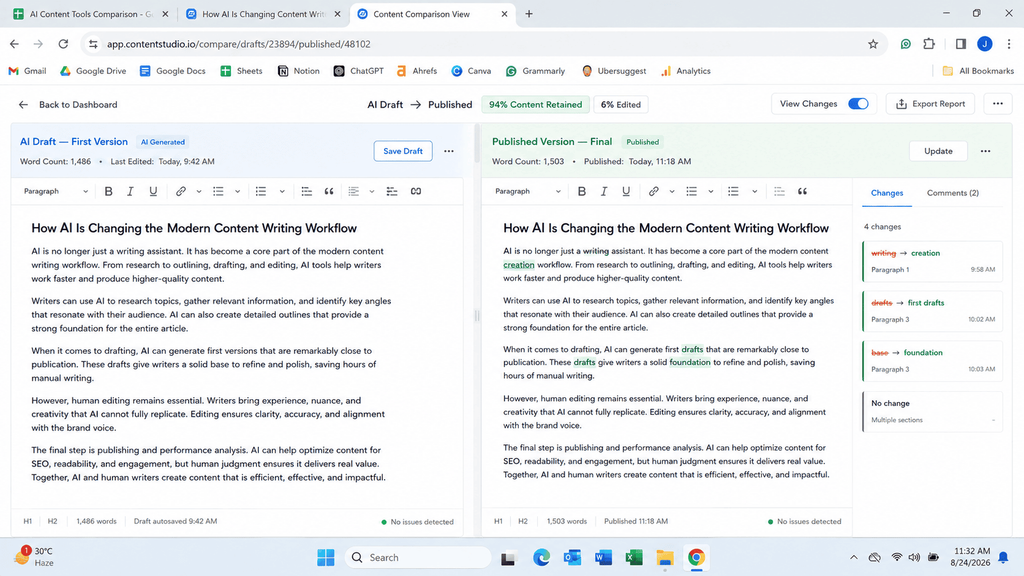
The outline prompts also worked well, especially the ones that asked for headings in the form of questions that a reader might ask, rather than ordinary topic headings. As my editor pointed out repeatedly, the presence of a well-made outline made the whole text more reliable, as it meant the author of the piece, regardless of whether human or not, was aware of the information the reader would need and could organize it accordingly.
Prompts That Needed Heavy Editing
The middle group, the eighteen that passed only after serious rework, tended to nail structure but miss substance. They produced technically correct paragraphs that said very little. Sentences would circle around a point without ever landing on it. My editor described a few of these drafts as sounding like a smart student who did the reading but never did the actual work in the field.
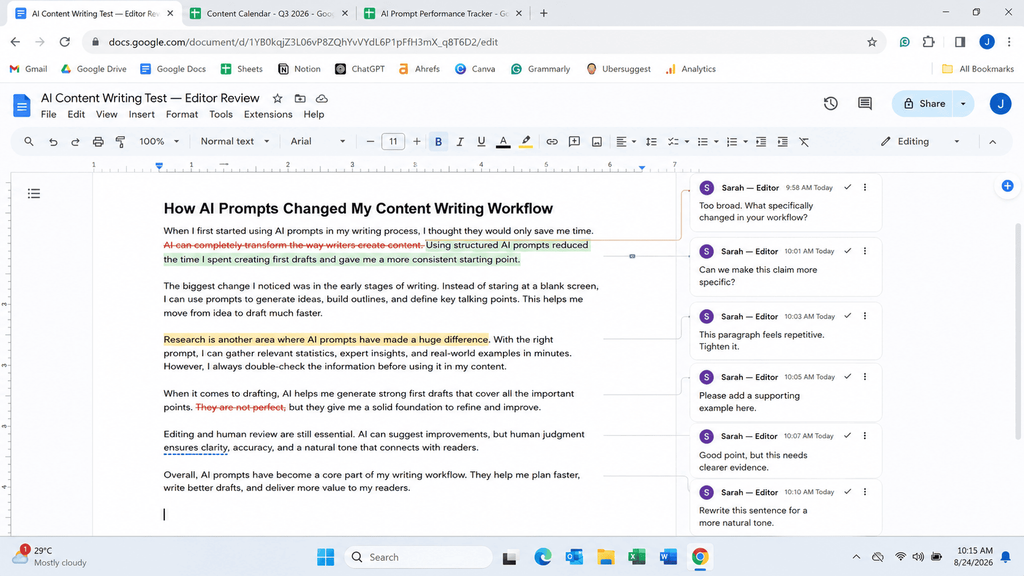
This group also struggled with transitions between ideas. AI models are good at generating individual paragraphs that sound fine in isolation, but stringing them together into an argument that builds toward a point is a different skill, and it is where a lot of these prompts fell apart.
Prompts That Failed Completely
The prompts that failed outright almost always asked for something broad and vague, like write a blog post about content marketing trends. No context, no target reader, no personal angle, nothing to anchor the output. The results were technically fluent but interchangeable with a thousand other articles already online. My editor’s exact note on one of these drafts was that it could have been published by literally any brand in any industry, which is the opposite of what a helpful, trustworthy piece of content is supposed to do.
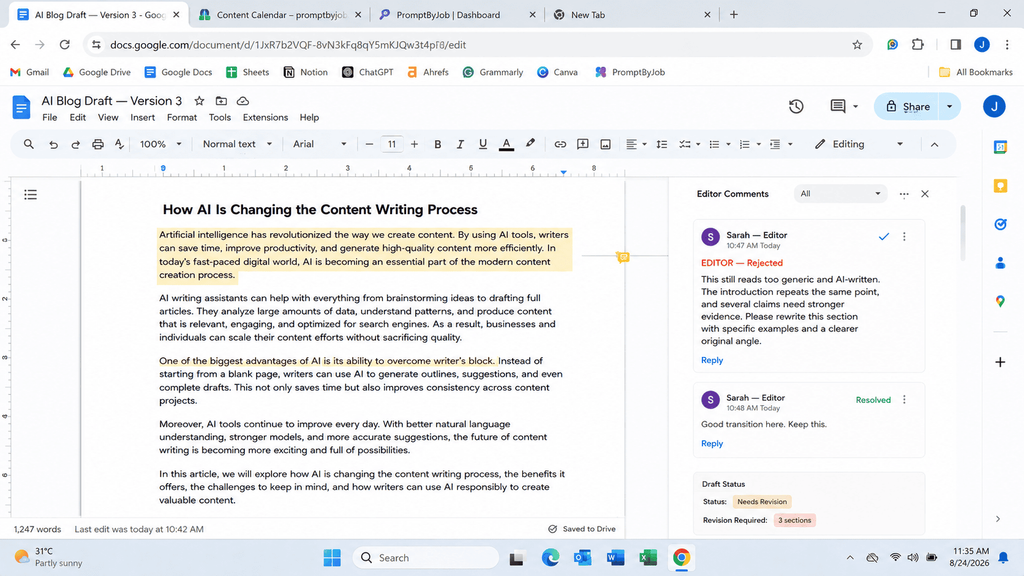
The following would also be the types of prompts to draw the most resistance from readers who will categorize them as clearly AI authored. Such a pattern occurs not because of any contextual words, but because these prompts fail to manifest a point of view.
What Actually Made A Prompt Pass Editorial Review
After going through every draft with my editor, three patterns stood out clearly enough that I now treat them as rules rather than suggestions.
Specificity Beats Cleverness
Read the draft below and find every sentence that makes a claim without a specific number, name, timeframe, or real example attached to it. List each vague sentence on its own line, followed by exactly one question asking for the specific detail needed to make that sentence credible. Do not rewrite anything yet. Do not suggest generic examples or invented statistics I could use instead. Wait for me to answer each question with a real detail before you touch the draft again.

Draft:
The single biggest factor separating a passing prompt from a failing one was specificity. Prompts that included a real number, a named tool, a specific timeframe, or an actual mistake I had made consistently outperformed prompts asking for general advice. If you want AI generated content that reads as trustworthy, feed the model specifics before you ask it to write anything.
Personal Experience Prompts Outperformed Generic Ones
Any prompt that asked the model to write from a first person perspective using details I supplied, rather than asking it to write as a generic expert, produced noticeably better results. This lines up with what search quality guidelines have been emphasizing for a while now. Content that demonstrates real experience with a topic tends to earn more trust from both readers and search engines than content that simply demonstrates knowledge about a topic.
Structure Prompts Saved The Most Editing Time
Build a complete outline for the topic below using only headings phrased as the exact questions a reader would type into Google or ask an AI assistant. Provide one H2 for each major stage of the topic, ordered the way a reader needs to learn them, not the order that sounds most impressive. Under every H2, list two to four H3 subpoints, each one a single specific detail, statistic type, comparison, or edge case, never a restatement of the H2 in different words. Do not include an introduction or conclusion heading. Do not use generic headings like overview, benefits, or final thoughts. Mark any H2 with an asterisk if you are not confident it can genuinely support three hundred words of specific, non repetitive detail.

Topic:
Even when a full drafting prompt failed, the outline prompts almost always survived. A strong outline gave my editor and me a shared skeleton to work from, which cut editing time dramatically even on pieces that needed a full content rewrite. If you only take one habit from this whole experiment, let it be this one. Generate your outline with AI, then write or heavily rework the actual sentences yourself.
The Three Categories Of Prompts Worth Reusing
Based on the full thirty day test, here are the prompt categories I kept using after the experiment ended.
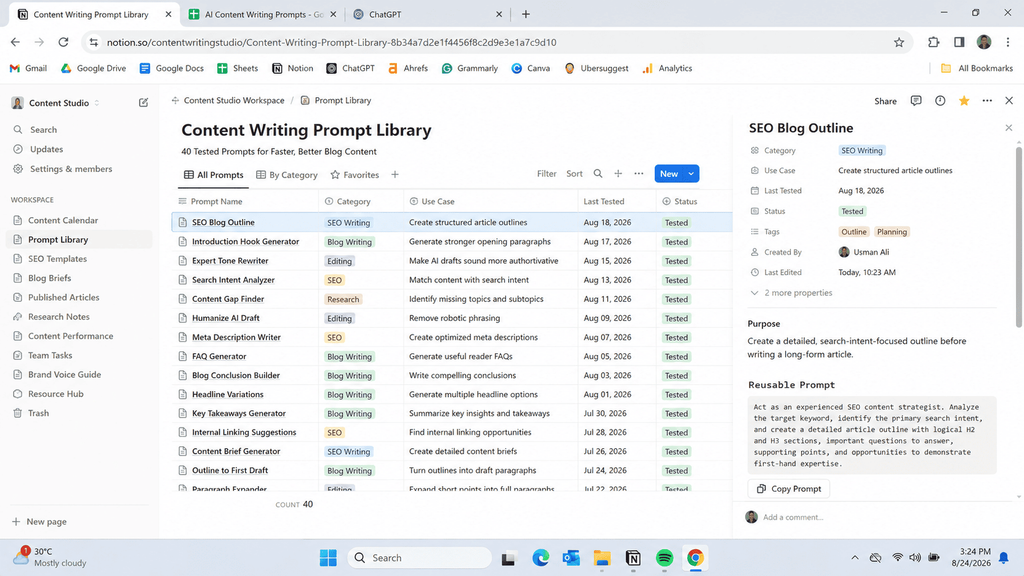
- Outline builders that ask for headings written as reader questions rather than topic labels. These consistently produced structures my editor approved with almost no changes.
- Voice matching prompts that include a real sample of my previous writing as reference material. Feeding the model an actual paragraph I wrote, then asking it to continue in that same voice, produced far more natural sounding output than asking it to sound conversational or professional in the abstract.
- Editing and tightening prompts used on my own rough drafts. Instead of asking AI to write from nothing, I write a messy first pass myself and ask AI to tighten sentences, cut redundant phrases, and flag weak transitions. This flips the entire workflow. The human does the thinking and the AI does the polishing, which is the opposite of how most people use these tools.
You will rewrite the draft below using my voice only. First, read the reference sample I provide and extract exactly three patterns: sentence length rhythm, transition style, and one word or phrase I overuse. State these three patterns in a single line before your rewrite. Then rewrite my draft keeping every specific number, name, and example unchanged. Do not add new claims, examples, or statistics that are not already in my draft. Do not soften or generalize any sentence that contains a specific detail. Cut any sentence that repeats a point already made elsewhere in the draft. Return only the three pattern line and the rewritten draft, nothing else, no preamble, no explanation.
What I Would Do Differently Next Time
If I ran this test again, I would spend less time on full drafting prompts and more time building a personal prompt library made entirely of outline and voice matching templates. I would also stop testing prompts on brand new topics and instead test them on topics I already know well, since it is much easier to spot a hollow AI paragraph when you already know what a genuinely useful answer looks like.
I would also loop my editor in earlier. Getting her specific pass or fail criteria before I started the test, instead of after a few weeks in, would have saved a good amount of wasted effort on prompt types that were never going to meet her bar.
A Simple Framework For Testing Your Own Prompts
If you want to run a version of this test yourself, here is the framework I would use going forward.
- Start by writing down exactly what your editor or your own quality bar actually checks for. Do not skip this step. Vague standards produce vague test results.
- Pick one topic you already know well and generate the same piece of content using three or four different prompt phrasings. Compare the drafts side by side rather than judging each one in isolation.
- Feed the model something specific before asking it to write anything, a real statistic, a real mistake, a real customer question you have actually heard. Generic input produces generic output every single time.
- Track your results the boring way, in a simple spreadsheet, noting which prompts needed heavy edits and which needed almost none. Patterns show up fast once you have ten or fifteen data points.
Final Verdict: Is AI Prompt Writing Worth It For Content Writers
After thirty days and forty prompts, my honest answer is that AI prompts are worth using, but only for specific parts of the writing process. They are excellent at outlining, tightening, and helping you move past a blank page. They are much weaker at generating finished, publishable content from a vague instruction, especially now that editors and search engines alike are actively screening for exactly that kind of hollow output.
The writers getting the most value out of AI prompts right now are not the ones asking a model to write an entire article for them. They are the ones using AI as a structural tool and a sentence level editor, while keeping the actual thinking, the specific details, and the real experience firmly in human hands.
FAQ’s
Can AI written blog content pass editorial review without heavy editing?
Some of it can, but based on this test, only about a quarter of AI generated drafts passed with light edits. The rest needed moderate to heavy rewriting, and content built from vague prompts usually failed outright.
What type of AI prompt produces the most usable blog content?
Outline and structure prompts consistently produced the most usable results, along with prompts that included specific personal details rather than asking the model to write in general terms.
Do editors and search engines actually penalize AI generated content?
They penalize thin, generic content regardless of who or what wrote it. Content that lacks specific detail, a clear point of view, or evidence of real experience tends to get flagged, whether it came from a human on a bad day or an AI model working from a vague prompt.
How many AI prompts should a content writer test before trusting one?
Test each prompt type on at least three or four real topics before deciding whether to add it to your permanent workflow. A single lucky result does not prove a prompt is reliable.

Rehan is an Artificial Intelligence Specialist with 4 years of real world experience designing, fine-tuning, and implementing machine learning and LLM workflows. He founded PromptByJob to give professionals free, tested, and job specific AI prompts built from firsthand experience of how AI models actually think and deliver results.