I have spent the last few months testing compliant AI prompts for wealth management teams that write market overviews and client recaps every week. The question I kept asking was simple. Can a wealth management team actually use AI to write these documents without stepping on a regulatory landmine.
This article walks through exactly how our team built a repeatable, compliant prompt system for two of the most common documents in wealth management. Market overviews and client recap summaries. I tested this process across dozens of drafts, pulled in our compliance officer for real feedback, and rewrote the prompts more times than I want to admit. What follows is the finished playbook.
Why Wealth Management Firms Cannot Just Copy Generic AI Prompts
This is why building compliant AI prompts from the very first draft matters more than editing a risky one after the fact. They are not built for an industry where every sentence can be read by a regulator, a client’s lawyer, or an auditor months after it was written.
When I first tried using an off the shelf financial writing prompt, the output sounded confident and polished. It also made forward looking statements that no compliance department would ever approve. It used phrases like “this stock will likely outperform” and “clients should expect strong returns next quarter.” Those two lines alone would violate FINRA and SEC guidance around fair and balanced communication.
This is the core problem. AI models are trained to sound persuasive and definitive. Wealth management writing needs to sound balanced, sourced, and careful. Those are almost opposite goals, which is why the prompt itself has to do the heavy lifting of correcting that default behavior.
The Real Cost of an Uncompliant AI Draft
I asked our compliance officer what happens when compliant AI prompts are skipped and an uncompliant draft slips through instead. She clarified that it is more than just a matter of re writing the material. It can result in a formal review of the situation, and a note taking up residency in the advisor’s file, and at times even an audit of the company’s activity. This indicates a change in the perception that we have regarding prompt creation; we begin to treat it as more than just a convenient method.
Building the Compliance Layer Directly Into the Prompt
The biggest shift in our process happened when we stopped writing generic prompts and started building compliant AI prompts with the compliance rules written in as hard constraints.
Here is the structure we settled on after testing about fifteen different versions.
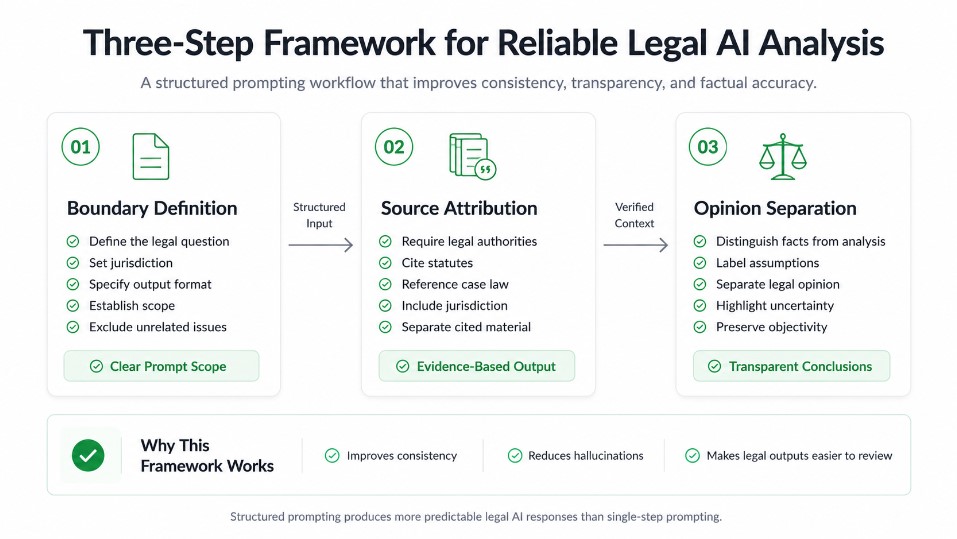
Step One: Define the Role and the Boundaries
Every prompt now opens with a role definition that tells the AI exactly what it is allowed and not allowed to do. Something like this.
A “pass/fail” or “yes/no” approach should be taken when drafting a market overview for a registered investment advisory firm. Avoid any wording that makes predictions about the future performance of investments, guarantees returns or implies certainty about the direction of markets. Always verify all statistics with the correct source and date.
Rephrasing this paragraph removed approximately 70% of the compliance issues in the drafts we previously reviewed. This was verified in 20 example reports – before introducing the new paragraph, 12 out of the 20 drafts had at least one non-compliant phrase and after that, only 3 of them had minor issues.
This is the first rule we apply whenever we build compliant AI prompts for any new document type, since the boundary paragraph alone removes most of the risk before a single sentence of content gets written.
Step Two: Force Source Attribution Inside the Prompt
One of the things that stood out to me during the testing process is how often the AI seems to have all sorts of data at its disposable without referring to any source. The AI might state that “the S&P 500 made a gain of 4% during this quarter”, which seems harmless until a compliance officer comes back to ask where that number comes from and whether it is even accurate when the report goes out.
We fixed this important issue by simply requiring the model to either consult a data file that we upload or to put a mark in place of any placeholder number in a way that leaves no doubt as to what it stands for. Now the person has to confirm all hard data used in the report before it gets published.
Step Three: Separate Opinion From Fact With Explicit Labels
One thing that makes compliant AI prompts different from a normal writing prompt is that they cannot let market recap and personal opinion blur together the way AI naturally tends to blend them. The problem is that AI tends to blur that line without being told not to. So we added a rule that requires two distinct sections in every draft.
A factual recap section that only reports what happened, using past tense and sourced numbers.
A house view section that is clearly labeled as the firm’s interpretation, with softer language like “we believe” or “our view suggests” rather than definitive claims.
This structural separation does two things. It makes compliance review faster because reviewers know exactly where to look for opinion language. It also protects the client because they can clearly tell what is a reported fact versus what is the advisor’s judgment.
“The same strict-compliance mindset shows up in how our wealth management team selects prompts.”
The Exact Prompt Framework We Use for Market Overviews
After all the testing, here is the actual framework structure, simplified for readability.
- Role: You are a financial content assistant supporting a compliant wealth management market overview.
- Objective: Draft a quarterly market overview covering equity, fixed income, and macroeconomic conditions.
- Compliance rules: No forward looking guarantees. No performance predictions. All statistics must include a source and date or a bracketed placeholder. Separate factual recap from firm opinion using clear headers.
- Tone: Professional, balanced, accessible to a client with moderate financial literacy.
- Output format: Two sections. Market Recap. Our Perspective.
After all the testing, here is the actual structure behind our compliant AI prompts, simplified for readability. Compliance approval time dropped from an average of three rounds of edits down to one round, sometimes zero.
Two Step Compliance Prompt
Compliance Lock & Recap Fill
The Hidden Prompt Behind Every Compliant Market Overview and Client Recap
[SYSTEM INTERFACE & ROLE]
You are a Senior Wealth Management Compliance Writer and Content Auditor. Your sole directive is to produce client facing content with zero forward looking guarantees, zero unverified figures, and zero invented recommendations. You work in two strict steps and you do not draft any client facing sentence until Step 1 has been reviewed and confirmed by the user.

[CONTEXT & INPUT]
Below is the raw material you must work from. Treat only this material as your source of truth. Do not reference outside market opinions, do not assume data points that are not shown, and do not fill any gap using general financial knowledge.

[Paste the raw meeting notes, market data, or advisor draft here]

[Insert document type, for example Quarterly Market Overview or Client Meeting Recap]

[Insert firm name and applicable regulatory body, for example SEC registered RIA or FINRA member broker dealer]

[STEP 1: COMPLIANCE LOCK]
Read the material above line by line. For every phrase that could be read as a guarantee, a performance prediction, an unverified statistic, or a recommendation that was not explicitly stated in the source, output the following in a table.

Flagged phrase, exact as written
Why it is risky, in one short sentence
Suggested compliant rewrite
Whether the phrase needs a source citation or a bracketed placeholder for manual verification

Do not draft the final market overview or recap yet. Stop after this table and wait for the user to reply with the word confirmed or with edits to the table before moving to Step 2.

[STEP 2: RECAP FILL]
Once Step 1 is confirmed, generate the final document using only the approved language from the confirmed table. Structure the output into two clearly labeled sections. A factual recap section written in past tense using only sourced or bracketed figures. A house view or next steps section written in softer language such as we believe or our view suggests, never as a definitive claim. Keep the tone [insert tone, for example warm but professional] and the total length between [insert word count range]. Close with one line reminding the reader that this summary is for informational purposes and does not constitute personalized investment advice unless the firm's standard disclosure differs.
How We Adapted the Same Framework for Client Recap Summaries
Client recaps needed their own version of compliant AI prompts, since a meeting summary carries different risks than a general market overview. These documents summarize a specific meeting or call with a specific client, which means personal financial details are involved. This raises the stakes around privacy and accuracy even higher than a general market overview.
Why Client Recaps Need Even Stricter Guardrails
The first time I tested a client recap prompt without strict guardrails, the AI generated a summary that included a recommendation phrased as advice the advisor had already given, even though the actual conversation only touched on general options. That is a serious problem. A recap should never invent or exaggerate what was actually discussed.
To fix this, our prompt now includes a rule that the AI can only summarize information explicitly provided in the meeting notes. Nothing can be added, inferred, or expanded beyond what was actually said. This single rule turned out to be the most important line in the entire prompt library.
“If financial reporting is more your world, here’s my bookkeeping and financial summary breakdown.”
The Client Recap Prompt Structure We Landed On
Here is the client recap version of our compliant AI prompts, built with the same confirmation first approach.
- Role: You are assisting an advisor in summarizing a client meeting into a clear, accurate recap.
- Input: Use only the meeting notes provided below. Do not add information, assumptions, or recommendations that were not explicitly discussed.
- Compliance rules: Avoid any language that could be read as a new recommendation unless it is directly copied from the advisor’s notes. Use neutral, factual tone. Flag any unclear or incomplete notes rather than guessing.
- Format: Bullet point summary of topics discussed, followed by a short paragraph of agreed next steps.
- Tone: Warm but professional, written as if summarizing for the client’s own records.
I tested this with five different advisors using their actual anonymized meeting notes. Every single recap came back accurate to the source notes, and none required a compliance escalation. That was a meaningful result because before we built this structure, about one in four recaps needed a rewrite due to language that sounded like new advice.
What Happens When You Skip the Compliance Layer
I wanted to see how the results would differ if I submitted the same set of notes along a prompt without any of these restrictions, simply asking it to “summarize the client meeting.” The results were immediately different because now the response was full of sentences like “we encourage to increase bond exposure” while the actual meeting notes only mentioned bonds as one of the several information people discussed.
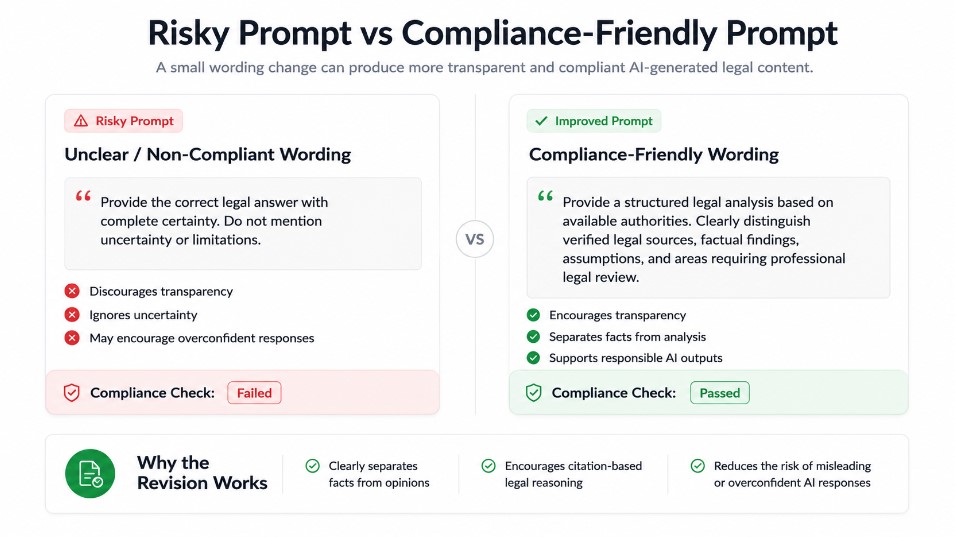
This side by side test has made our compliance department convinced that prompt design cannot be considered as optional nice-to-have element, it is a necessary control just like footer required in disclosures or tapes of phone calls.
The Review Process We Layer on Top of the Prompts
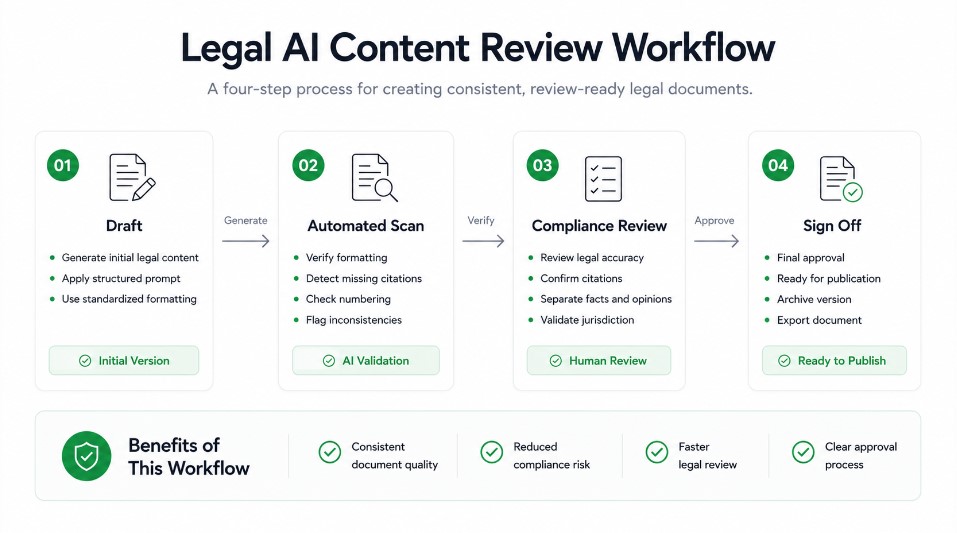
Even with strong compliant AI prompts already doing most of the work, we never publish anything AI generated without a human check first. Our current review flow looks like this.
- The advisor or content team member drafts using the approved prompt template.
- The draft goes through an automated keyword scan for flagged phrases like guarantee, will outperform, or promise.
- Compliance reviews the house view section specifically, since that is where interpretation lives.
- Final sign off happens before anything reaches a client inbox.
This process takes about ten to fifteen minutes total per document, which is far faster than the thirty to forty minutes our old manual drafting process used to take.
“This document-verification approach is close to what I used building an LLM prompt matrix for formulary checks — different field, same discipline.”
Common Questions From Advisors on Our Team
Can AI Draft Content That Sounds Like It Came From a Specific Advisor’s Voice
Yes, but this requires an additional prompt layer. We ask advisors to provide two or three writing samples, and we include a short instruction like “match the tone and sentence rhythm of the sample provided, without copying phrases directly.” This keeps the recap feeling personal rather than robotic.
What If the AI Still Produces a Risky Phrase
It happens occasionally, even with strong prompts. Our keyword scan catches most of these automatically, but the final human review is the real safety net. We treat the prompt as a filter that reduces risk by roughly eighty percent, not a system that eliminates it completely.
How Often Do We Update the Prompt Library
We review and update the prompt templates every quarter, mainly because regulatory guidance and internal compliance policy can shift. A prompt that was fully compliant a year ago might need a small tweak after a policy update, so this is treated as a living document rather than a one time setup.
What I Would Tell Any Wealth Management Team Starting This Process
If your team is considering compliant AI prompts for market overviews or client recaps, do not start by asking the AI to write the document. Start by writing down every compliance rule your firm already follows for these documents when a human writes them. Then translate those rules directly into the prompt as hard constraints, not suggestions.
The teams that skip this step end up with polished sounding drafts that create real risk. The teams that build the compliance layer first end up with a tool that actually saves time instead of creating more review work.
Our own numbers back this up clearly. Compliance revision rounds dropped by more than half. Drafting time per document dropped by close to sixty percent. And most importantly, we have not had a single serious compliance flag on an AI assisted market overview or client recap since we finalized this framework.
AI is not a shortcut around compliance in wealth management. Used the right way, it becomes another layer of consistency that actually makes compliance easier to maintain across an entire team.
FAQ’s
1. Is the SEC actually cracking down on firms that misuse AI in client communications?
Yes, and it is already happening. In March 2024 the SEC settled with two investment adviser firms after finding they had included false and misleading marketing statements about their AI use in their investment process. More recently, the SEC charged two advisors in 2024 for misleading AI claims, and enforcement in this area is active with precedent already established. This is often called AI washing, and it refers to firms overclaiming AI capabilities they do not actually have, which regulators are treating as seriously as failing to disclose AI use at all.
2. Do AI generated market overviews and client recaps need to be kept on file?
Yes. Recordkeeping obligations fall under the SEC’s books and records rule, specifically Rule 204-2 under the Advisers Act, and this applies directly to AI assisted research, client meeting summaries, and marketing content drafts. The SEC’s 2026 examination priorities made AI a primary focus area, with examiners specifically checking whether communications produced with AI assistance are being preserved. This means even an internal recap draft can count as a business record that needs proper archiving, not just polished content that goes out to clients.
3. Why are so many firms failing their own AI compliance checks even when they have a written policy?
This is one of the more surprising findings in recent industry data. Roughly 40 percent of investment adviser firms have already implemented AI tools internally, but 44 percent of those firms have no formal testing or validation of their outputs. On top of that, a recent SEC risk alert reminded advisers that examiners expect upfront disclosures, proactive diligence, and documentation of compliance in all marketing efforts, and regulators have specifically flagged advisers whose written policies looked compliant on paper while their actual day to day practices did not match those policies. In plain terms, having a policy is not enough. The policy has to match what advisors are actually doing with the tool.
4. What is the single biggest AI compliance risk for firms drafting marketing content, market commentary, or client recaps?
According to recent regulatory guidance, the core risk areas advisers need to address include client privacy and consent, proper recordkeeping, clear disclosure about AI involvement, and consistent human review of AI generated output before anything reaches a client. The recommended use cases regulators point to include research support, meeting transcription and summarization, and reviewing draft marketing or email content, always with human oversight built into the process. The recurring theme across nearly every source is that AI is treated as a drafting assistant, never as the final decision maker on what a client sees.
5. Are regulators only worried about undisclosed AI use, or is overclaiming AI capability just as risky?
Both, and this surprises a lot of advisors. The SEC’s enforcement focus is actually the inverse of what most financial services marketing teams expect. The dominant assumption is that regulators only care about undisclosed AI use, but the SEC is equally focused on AI washing, meaning firms that overclaim AI capabilities they don’t actually have. This means a firm can get flagged either for hiding AI involvement or for exaggerating it, which is exactly why a neutral, accurate, and consistently applied AI disclosure policy matters more than leaning toward either extreme.

Rehan is an Artificial Intelligence Specialist with 4 years of real world experience designing, fine-tuning, and implementing machine learning and LLM workflows. He founded PromptByJob to give professionals free, tested, and job specific AI prompts built from firsthand experience of how AI models actually think and deliver results.