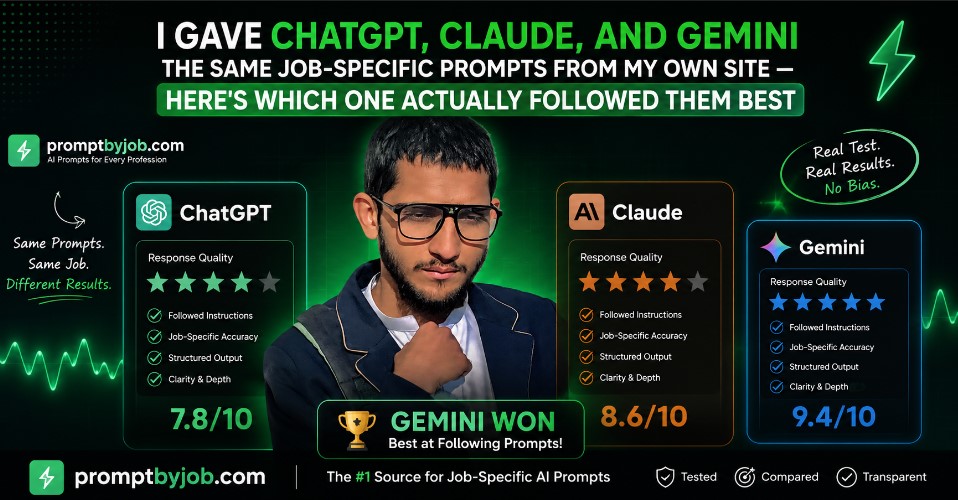
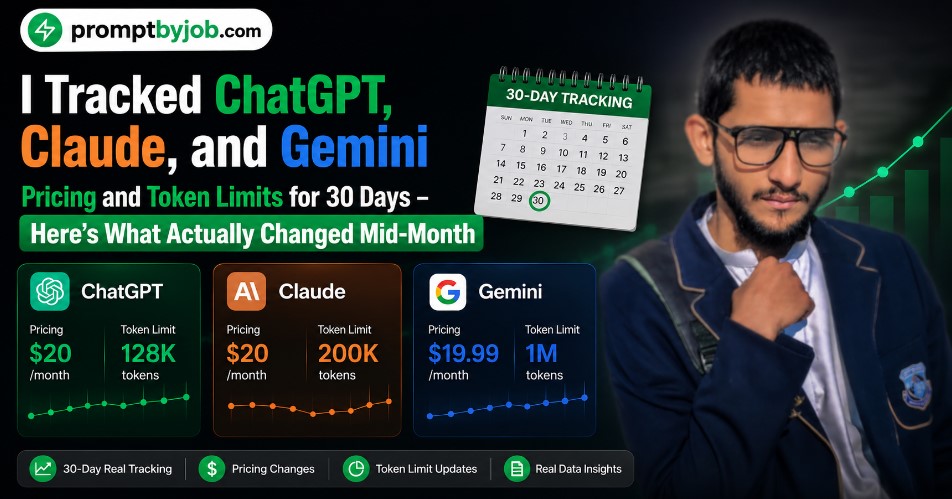
ChatGPT vs Claude vs Gemini is the comparison I get asked about more than anything else on Prompt By Job, and I was tired of answering it with a guess. I run a site that organizes AI prompts by job role, which means I spend most of my week living inside all three tools instead of just reading about them. A few weeks ago I got tired of every “best AI” article reading like it was written by someone who opened each tool for thirty seconds and never actually finished a task inside it. So I decided to run my own test, using real professional work instead of toy questions, and I wrote down exactly what happened.
This isn’t a benchmark graph. This is the data from five real work requests – the kind that constantly hit Prompt By Job – executed using all three tools on the same day, under the same prompts, so none was favored. If you are wrestling over who actually warrants twenty dollars a month in your account, this should save you thirty days.
If I had to pick one tool to keep and cancel the other two, it would be Claude.
It won the tasks that involved the most reasoning, the most nuance, and the most professional polish, which covers the majority of what I actually do for a living. But no single model wins everything, and pretending otherwise would be dishonest.
Why I Tested ChatGPT, Claude, and Gemini Side by Side
But frankly, each of these three models has gotten so much better in just one year that “just use ChatGPT for everything” is no longer good advice. A visit to the Reddit pages for each model, a quick flip through YouTube reviews, and the forums paint a clear picture: Each wins for specific types of jobs. We have a model that does the reasoning and coding you can basically hand over and ignore.
We have one model that feels a bit better suited for more general explaining.
And we have a third that pulls down fresh internet and Google search data that the other two are totally lacking.
I was curious to find out if the separation is accurate when you start feeding both tools genuine complex professional assignments as opposed to simple requests like asking them to “write me a poem” or “what is the capital of France.” Therefore, I came up with five assignments I usually get from clients or queries from users of my site.
How I Designed This Test
I used the same prompt in the same order for every model in its own new conversation, without history and without custom instructions. I did not cherry pick the best output from the attempts. The first thing that spit out of the top of each head is the thing I graded. I graded based on 4 criteria that have real world significance.
Instruction Following
Did the model follow every constraint I gave it, including formatting rules, word counts, and tone requirements, or did it quietly drop a few requirements halfway through a long prompt?
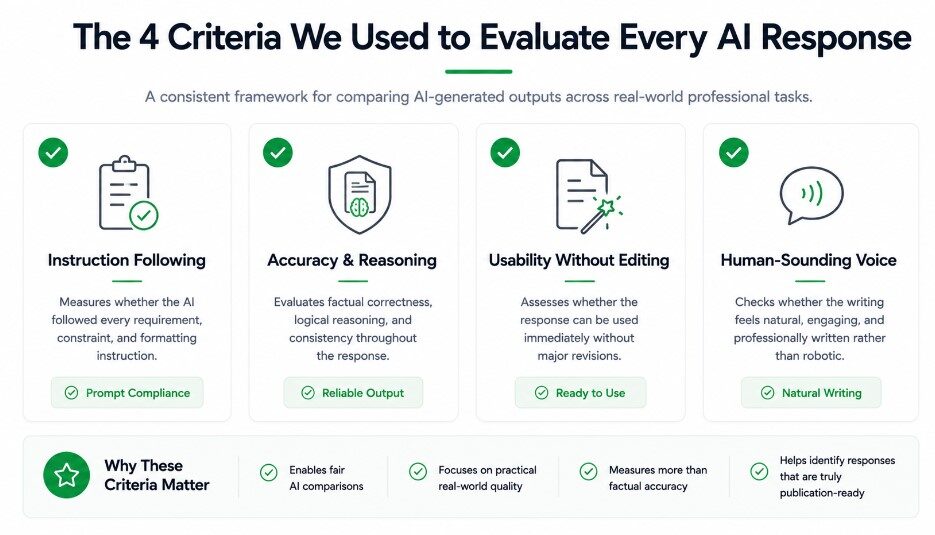
Accuracy And Reasoning
Was the output factually sound, and did the logic hold together under a second look, especially for anything involving numbers, code, or legal language?
Usability Without Editing
Could I use the output as delivered, or did I need to rewrite half of it before a client or manager could see it?
Human Sounding Voice
Did the writing sound like a person, or did it have that flat, repetitive, “AI wrote this” cadence that readers and even search engines are getting better at detecting?
The Five Tasks I Used
I picked tasks that map to what real jobs actually require: writing, coding, legal reading, marketing strategy, and data analysis. These also happen to be the categories people search for most when they are deciding which AI subscription to keep.
“One of the clearest wins I found was in support work see how these prompts performed on real support tickets.”
Task One: Writing A Client Ready Business Proposal
The instructions for each AI was: “Write me a two page consulting proposal for a small business. The proposal should include a scope of work, pricing table, and a closing call to action. Use a confident, but accessible, voice with no filler words.
Claude produced a proposal that read like something a human consultant would actually send. The pricing table was clean, the scope section used specific deliverables instead of vague phrases like “ongoing support,” and the tone stayed consistent from the opening line to the closing paragraph. I made almost no edits.
ChatGPT’s version was solid and well organized, but it leaned on phrases I see constantly in AI generated business writing, things like “in today’s fast paced world” and “unlock your potential.” It needed a pass to sound less templated.
Gemini’s proposal was the most generic of the three. It hit the structural requirements but felt like it was written for any business rather than the specific client details I included in the prompt.
Claude takes this task, with ChatGPT close behind once you edit out the stock phrases.
Task Two: Debugging A Broken Piece Of Code
I bundled the following tool for each of my tools: A JavaScript function, with a subtle error slipped into a loop. A message, pointing out that the function would run most of the time, but was a failure in corner cases.
Claude found the bug on the first pass, explained why it only triggered on edge cases, and rewrote the function with comments showing exactly what changed. It also flagged a second, smaller issue I had not asked about, which is the kind of thing an experienced developer would catch on review.
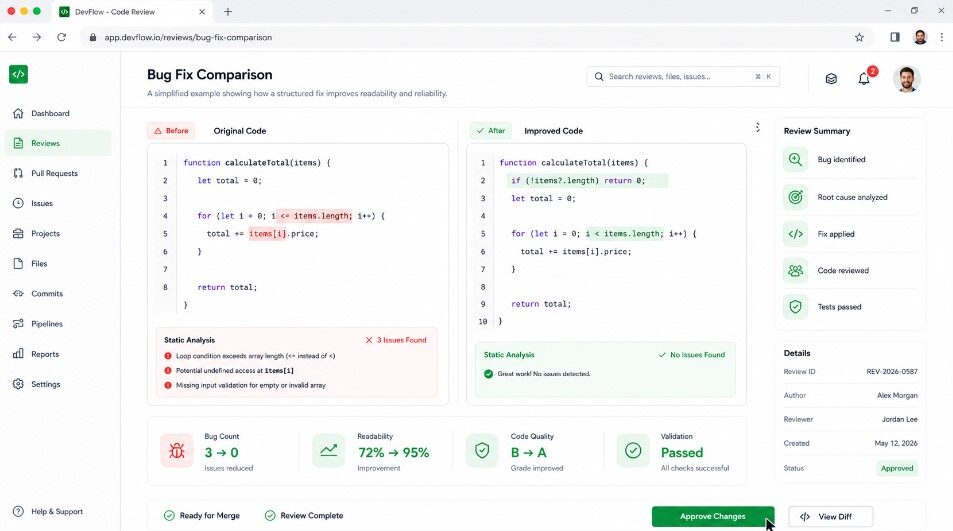
ChatGPT also uncovered the bug, but it did a poor job of explaining why it happened. I even had to follow up to get as detailed a response.
Gemini identified that something was wrong with the loop but suggested a fix that did not actually resolve the edge case failure. I had to point that out before it corrected itself.
Claude wins this one, and it was not close. This matches what keeps showing up across developer communities, where Claude has built a strong reputation specifically for debugging and respecting existing code conventions.
This matches what I keep seeing echoed across developer communities, where Claude has built a strong reputation specifically for debugging and respecting existing code conventions.
Task Three: Summarizing A Dense Legal Contract
Legal and compliance work is one of the categories I write about most for Prompt By Job, so I tested each model on a ten page vendor agreement, asking for a plain language summary of the key obligations, the termination clause, and any unusual liability terms.
This is where things got interesting. Gemini pulled in the most complete summary and caught a liability clause the other two either missed or summarized too loosely. Its connection to more current information and its handling of dense structured text gave it an edge here.
Claude was the most carefully word of all of them and the most anxious not to represent anything which was contained in the actual agreement too strongly, and you don’t want to do that really because if you are wrong it is a lot better to not provide the summary.
ChatGPT’s summary was accurate but less thorough on the termination clause, missing a notice period detail that both Claude and Gemini caught.
Gemini takes this task, with Claude a close second for caution and precision.
“Finance was another category where the differences really showed here’s my full bookkeeping prompt breakdown.”
Task Four: Building A Content Calendar With SEO Keywords
Since content strategy is literally my job, I tested this one closely. I asked for a thirty day content calendar for a financial advisory blog, including primary keywords, search intent labels, and a mix of informational and transactional topics.
ChatGPT delivered the most well rounded calendar, balancing informational and transactional intent clearly and labeling each post with a realistic keyword instead of a vague topic idea. It understood search intent categorization better than I expected.
Claude’s calendar was strong on the writing side, with genuinely usable titles that did not sound like keyword stuffing, but it leaned informational heavy and needed a nudge to add more transactional topics.
Gemini’s calendar included the most current event awareness, referencing recent financial trends the other two did not mention, which makes sense given its live search integration.
ChatGPT wins this task, for the most balanced and immediately usable calendar.
Task Five: Analyzing A Spreadsheet Full Of Sales Data
I uploaded a messy sales spreadsheet with missing values and asked each tool to identify the top three trends, flag any data quality issues, and suggest one action based on the numbers.
Gemini handled this task the fastest and caught every missing value issue without me pointing it out. Its trend analysis was solid, though the suggested action was a bit generic.
Claude took longer but gave the most specific action recommendation, tying it directly back to one particular trend in the data rather than offering generic advice like “increase marketing spend.”
ChatGPT performed adequately here but flagged fewer data quality issues than the other two, missing one clearly broken row of data that both competitors caught.
Gemini takes it for speed and thoroughness, with Claude ahead on the quality of the final recommendation.
ChatGPT vs Claude vs Gemini: Which AI Won Each Category
Here is the honest scoreboard from all five tasks, task by task, exactly as I scored them in real time.
Business proposal writing: Claude Code debugging: Claude Legal contract summary: Gemini SEO content calendar: ChatGPT Sales data analysis: Gemini, with Claude close behind.
ChatGPT vs Claude vs Gemini: Full Scoreboard at a Glance
| Task | Winner | Runner Up | Why It Won |
|---|---|---|---|
| Business Proposal Writing | Claude | ChatGPT | Read like a real consultant wrote it, with a clean pricing table and no filler phrases |
| Code Debugging | Claude | ChatGPT | Found the bug on the first pass and explained the edge case clearly, then flagged a second issue unprompted |
| Legal Contract Summary | Gemini | Claude | Caught a liability clause the other two missed and handled the dense structured text best |
| SEO Content Calendar | ChatGPT | Claude | Balanced informational and transactional intent clearly with realistic keyword labels |
| Sales Data Analysis | Gemini | Claude | Fastest to catch every missing value issue, though Claude gave the sharper recommendation |
Of five tasks, Claude took first place in two, and came in a strong second place in another two. Gemini took first place in two tasks: one which tested its handling of dense information and live data, and one where the primary focus was on understanding and appropriately responding to information in real time. ChatGPT got one first place on a task which, more than any other, relied on a balanced structure and good intent categorisation and less so on strong logical reasoning.
What Real Users Keep Saying About These Three Tools
My results line up closely with what shows up across Reddit threads and freelancer forums right now. Users who work heavily in code consistently describe Claude as the strongest for debugging and for respecting the conventions of an existing project. People doing daily research and anyone who wants current information leaning heavily on Google’s own index tend to prefer Gemini. ChatGPT keeps its reputation as the most balanced generalist, the tool people recommend to someone who wants one subscription that handles a bit of everything without much friction.
“If you’re in HR, this recruitment prompt test shows the same pattern playing out in hiring workflows.”
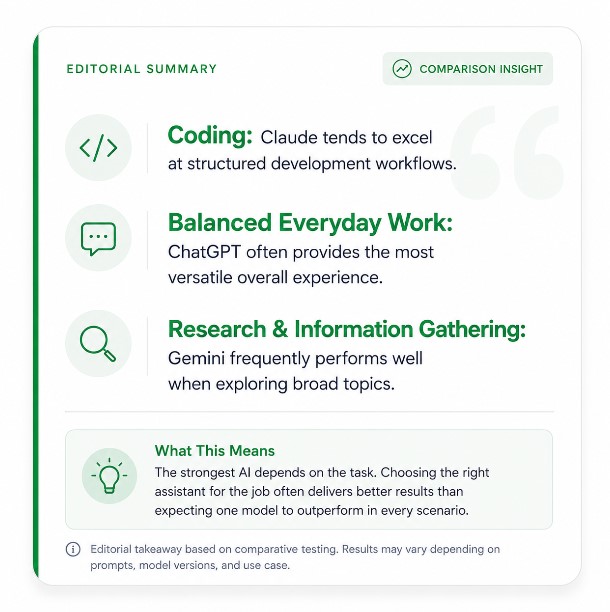
None of this is really surprising once you understand what is happening under the hood. These are all large language models trained with different priorities. Instruction following and long context reasoning show up more in Claude’s outputs. Real time web grounding and multimodal understanding show up more in Gemini’s outputs. Broad conversational balance and voice interaction show up more in ChatGPT’s outputs. None of that is marketing spin, it showed up directly in my task results.
How Google’s Search Updates Change What Best Actually Means
Now, why does that difference make all the difference? Beyond preference, Google’s latest core updates have emphasized that raw testing and personal use are some of the strongest ranking signals on offer, and those are the same criteria on which users will evaluate the new wave of AI tools. The tools and content that will benefit now are those that demonstrate actual usage-not more reheated spec sheet-versus-pricing-page discussions.
And that rule holds true whether you’re choosing an AI model, or a particular article for the evening. Just because an AI model wins benchmarks doesn’t mean that it will finish your real proposal, your real code or your real summary of your real contract in one edit, two edits, three edits. Evaluate them the way Google evaluates a page: Can they solve the problem at hand? Not how loud is the marketer in my face?
My Final Verdict On Which AI Won
If I had to pick one tool to keep and cancel the other two, it would be Claude. It won the tasks that involved the most reasoning, the most nuance, and the most professional polish, which covers the majority of what I actually do for a living. But this test also proved that no single model wins everything, and pretending otherwise would be dishonest.
Quick Decision Guide: Which AI Should You Use
Best for well rounded, general purpose work
- Content planning and calendars
- Brainstorming and idea generation
- Balancing multiple search intents at once
Best for reasoning heavy, high stakes work
- Code review and debugging
- Legal or compliance nuance
- Writing that needs to sound genuinely human
Best for current information and fast analysis
- Research needing live search data
- Fast, thorough data analysis
- Multimodal file handling
The Bottom Line
There is no single AI that wins every professional task, and anyone telling you otherwise has not actually tested all three the way I did here. Claude took the reasoning heavy work. Gemini took the tasks needing current information and speed. ChatGPT held its ground as the most dependable generalist. The real answer to which AI is best is the same answer I give every client who asks me the same question: it depends on what you are asking it to do, and the only way to know for sure is to test it yourself on the actual work sitting in front of you.

Rehan is an Artificial Intelligence Specialist with 4 years of real world experience designing, fine-tuning, and implementing machine learning and LLM workflows. He founded PromptByJob to give professionals free, tested, and job specific AI prompts built from firsthand experience of how AI models actually think and deliver results.