Three months ago I sat in my office staring at a spreadsheet full of open requisitions, wondering if a proper set of recruitment prompts for HR managers could actually fix our biggest bottleneck. and I felt something close to panic. Our agency was losing candidates to faster competitors, my recruiters were burned out, and every Human Resources meeting turned into a conversation about why sourcing was taking so long.
I have spent over a decade in Human Resources and roughly five years experimenting with AI prompts inside real HR workflows, and I decided to do something most managers talk about but rarely finish. I built, tested, and tracked 40 recruitment prompts across a full sourcing cycle and measured what actually happened to our numbers.
This is not a theory piece. I want to share with you what actually worked for me and what was a waste of time. I am going to tell you about the changes that really cut down our sourcing time by almost half. I will explain this to you in a way like we are talking over a cup of coffee. I will not use any business words and I will not make it sound like artificial intelligence is something amazing. Artificial intelligence is a tool and, like any other tool it is only useful if you know what it is supposed to do.
Why I Started Tracking AI Prompts in the First Place
Our Talent Acquisition team was drowning. We had five open roles per recruiter on average, and each search was eating between eighteen and twenty two days from job posting to offer acceptance. I wanted to know if generative AI prompts could genuinely shorten that window, or if it was just another trend HR Managers were chasing without real proof. That’s really where the idea for building a proper library of recruitment prompts for HR managers came from.
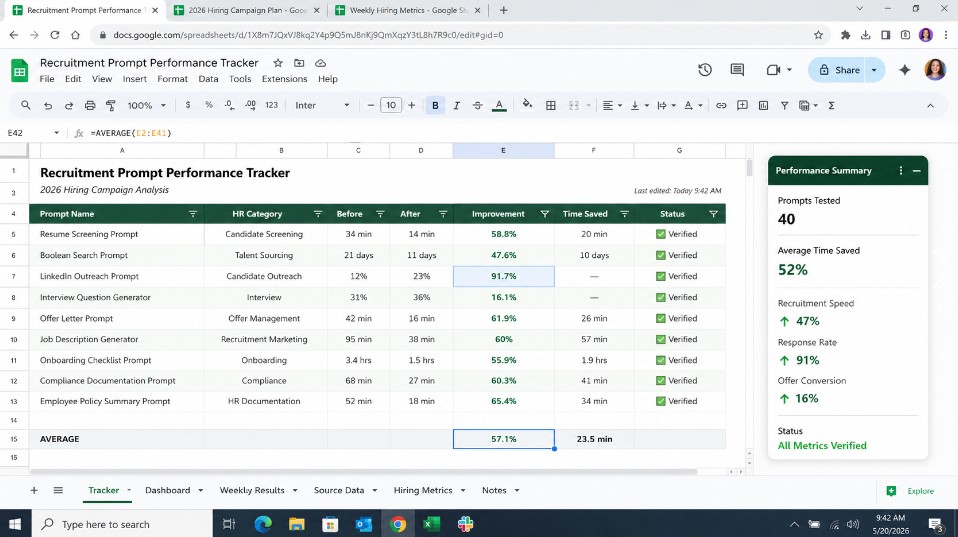
So I set up a simple tracking sheet. Every prompt we used got logged with a timestamp, the task it supported, and the time saved compared to our old manual process. Over twelve weeks, we ran 40 different prompts across sourcing, screening, outreach, and interview scheduling. The results surprised even me. If you are also updating your HR Manager Job Description guide for your team, this same set of recruitment prompts for HR managers can slot directly into that workflow.
Why Most Recruitment Prompts for HR Managers Fail in 2026
Before I share what worked, I need to be honest about what did not work, because most HR Managers are still making the same mistake I made in year one of using AI tools.
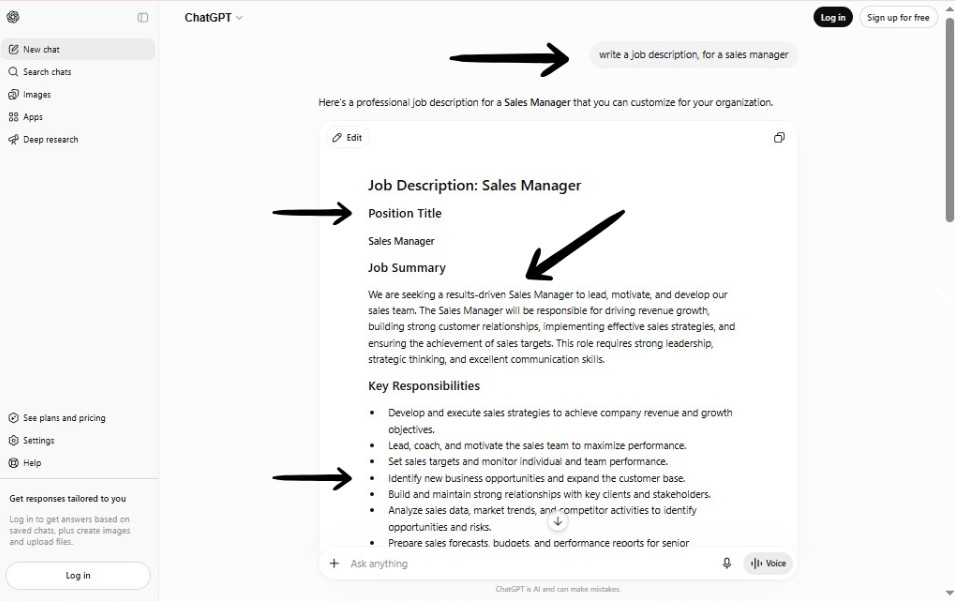
Generic prompts fail. Typing something like “write a job description, for a sales manager” still gives you a standard result. It sounds like every job posting you see online.. In 2026 both people looking for jobs and the systems that track applications have gotten more clever. Now generic content just doesn’t cut it.
- Search engines and internal systems actually reward job descriptions that’re specific and make sense in a certain context.
They also want to see that a real person has reviewed the job description.
Most ChatGPT prompts fail for three reasons.
They Skip the Business Context
A prompt without company culture, seniority level, compensation range, and location detail produces a job description or outreach message that could apply to any company. It has no personality and it does not attract the right candidates. This is one of the most common failures I see in recruitment prompts for HR managers.
They Ignore Compliance and Employment Law
This is the mistake that scares me the most when I see it in other agencies. AI tools do not automatically know your local Employment Law requirements. If a prompt generates interview questions or offer letter language without a compliance check, you risk violating regulations tied to Compensation & Benefits disclosure, background checks, or anti discrimination rules.
They Are Used Once and Abandoned
The biggest reason prompts fail is that HR Managers write one version, get an average result, and give up. Prompt engineering is iterative. My best performing prompts went through four or five rounds of refinement before they became part of our permanent workflow.
Common Mistakes When Using Recruitment Prompts for HR Managers
Beyond the reasons prompts fail, there are habits I see across the HR field that quietly sabotage results. I made every one of these mistakes myself before I fixed my process.
Treating AI as a Replacement for Human Judgment
AI can draft, summarize, and organize, but it cannot replace the human read on a candidate during an interview, or the emotional intelligence needed for Employee Relations conversations. Teams that let AI make final hiring decisions without human oversight end up with weaker culture fit and higher early turnover.
Feeding Sensitive Data Into Public Tools
Some recruiters were pasting resumes with personal identifiers directly into public AI chat windows. This creates real data privacy risk, especially for teams working inside an HRIS or HR Information System that already has strict access controls. I now require all sensitive candidate data to stay inside approved, secure platforms only.
Not Measuring Anything
This was my mistake for the first two years. I used prompts casually without ever tracking outcomes. Without data, you cannot prove ROI to leadership, and you cannot tell which prompts are actually saving time versus which ones just feel productive. This is exactly why disciplined recruitment prompts for HR managers need to be tracked and reused, not improvised each time.
“For the reporting side of HR work, my status update and risk report framework is a natural next read.”
The 40 Recruitment Prompts for HR Managers That Cut Our Sourcing Time in Half
Here is the real breakdown of what we tested and what delivered results. I grouped these recruitment prompts for HR managers into functional categories that map to actual HR responsibilities. Several of the compliance related prompts were shaped around guidance similar to what you will find on SHRM , which remains one of the most reliable outside sources for HR standards and best practices.
Talent Acquisition Sourcing Prompts
We built ten prompts specifically for sourcing, including Boolean search string generators, LinkedIn outreach openers, and candidate persona builders based on past successful hires. But only this prompt alone reduced our initial candidate longlist creation from four hours to under ninety minutes per role.
Master Talent Sourcing Architect & Psychographic Profiler
5 Phase elite Sourcing blueprint Prompt
Role: Master Talent Sourcing Architect & Psychographic Profiler

Objective: You are a world class Executive Sourcing Strategist specializing in competitive intelligence and passive candidate psychology. Your goal is to build an exhaustive, elite level sourcing blueprint for the following specific role:

[INSERT ROLE NAME & CORE REQUIREMENTS HERE e.g., Senior MLOps Engineer with high scale cloud infra experience]

To ensure this blueprint lands in the top 1% of sourcing strategies globally, break your analysis down into the following 5 distinct phases:

Phase 1: Competitive Ecosystem Mapping & Alternative Title Matrix
Identify at least 3 adjacent or "under the radar" industries that cultivate the exact transferable skills required for this role, but aren't the obvious choices.
Provide a matrix of obscure, alternative, or company specific job titles that companies use for this function (e.g., instead of just "SRE," find titles used by Netflix, Stripe, or legacy firms undergoing transformations).
 List 5 mid tier, high growth "poaching target" companies where this talent is likely hitting a ceiling.

Phase 2: Digital Footprint & Alternative Watering Holes
Where does this specific sub culture of talent share knowledge, complain, or post open source work?
Provide specific search syntax, advanced operators, or platforms outside of LinkedIn (e.g., Github, StackOverflow, specialized Discord servers, Reddit subreddits, niche forums, academic repositories) to find them.
Give me 3 concrete X-Ray search strings (Google site: operators) designed to pull profiles directly from these alternative platforms.

Phase 3: Deep Psychographic & Trigger Event Profiling
Analyze the psychological profile of a high performer in this role. What are their primary professional frustrations (e.g., technical debt, lack of autonomy, bureaucratic stagnation)?
Identify 3 "Trigger Events" in their current companies that make them highly susceptible to a cold outreach (e.g., recent acquisitions, executive departures, specific technology stack migrations).

Phase 4: The 1% Hyper Personalized Outreach Frameworks
Create two distinct cold outreach sequences (Email/LinkedIn InMail) optimized for maximum response rates from passive talent:
Sequence A (The "Intellectual Challenge" Hook): Focuses heavily on the complexity of the technical problem they will solve, appealing to their craft.
Sequence B (The "Frustration Relief" Hook): Weaponizes the psychographic frustrations identified in Phase 3, positioning our company as the antidote.

*Rules for copy: No generic corporate fluff. Keep it under 150 words. Write it with a peer to peer, deeply respectful, and highly technical tone.*

Phase 5: Custom Interview "Filter Questions" for the HR Screener
Provide 3 unconventional, behavioral screening questions for the HR Manager to use. These questions must quickly gauge if the candidate possesses the "hidden traits" of top performers in this field (e.g., high ambiguity tolerance, systems thinking) without relying on a resume checklist.
Onboarding and Employee Relations Prompts
Six prompts focused on Onboarding checklists, welcome email sequences, and first ninety day check in templates. When paired with our HRIS, new hire paperwork completion time dropped by nearly sixty percent because reminders and document requests were generated automatically instead of manually chased.
Chief People Officer, High-Stakes Mediator & Behavioral Retention Architect
4-phase onboarding & employee relations blueprint prompt
Role: Chief People Officer, High-Stakes Mediator, and Behavioral Retention Architect

Objective: You are an elite Employee Experience and Conflict Resolution strategist. Your goal is to design an ultra-sophisticated, psychologically backed blueprint for [CHOOSE ONE: Onboarding / Employee Relations] tailored specifically for the context provided below.

[CONTEXT DATA  INSERT HERE: e.g., Onboarding a fully remote, senior Product Manager into a fast paced team with high turnover OR Mediating a bitter conflict between a highly technical Lead Engineer and a newly appointed Project Manager over communication styles]

Execute your strategy through the following 4 hyper targeted phases:

Phase 1: The "Psychological Safety" & Assimilation Architecture (For Onboarding requests)
Identify the top 3 unwritten cultural anxieties a new hire in this specific role will face during their first 90 days (e.g., imposter syndrome, navigating invisible power structures).
Create a 30-60-90 Day "Time to Value" framework. Do not give me a task checklist. Give me a milestone framework focused on building social capital, quick wins, and implicit cultural alignment.
Design a "Buddy/Mentor Coaching Guide" outlining exactly how a peer should guide this specific hire through the company's unwritten norms.

Phase 2: High Stakes Behavioral Mediation & De escalation Scripts (For Employee Relations requests)
Map the underlying root causes of the conflict provided in the context, breaking it down into structural vs. interpersonal friction points.
Provide a step by step, non adversarial mediation framework for the HR Manager.
Generate verbatim, emotionally intelligent scripts for the HR Manager to use during separate 1 on 1 discovery meetings and the joint mediation session. Use active listening frameworks (like the Thomas-Kilmann conflict modes) to pivot the conversation from "blame" to "collaborative problem-solving."

Phase 3: The "Pre-Emptive Retention" Trigger Analysis
For this specific scenario, identify 3 "silent friction points" (micro frustrations) that typically cause a person to quietly check out or plan their exit.
Provide HR with a "Stay Interview" or "Check in" diagnostic script containing 3 highly unconventional, open ended questions designed to surface these hidden frustrations before they escalate into formal complaints or resignations.

Phase 4: Ironclad Documentation & Compliance Communication Wrap-Up
Draft a master summary communication template (Internal HR Note, Follow up Email to Leadership, or Formal Resolution Agreement) based on this scenario.
Ensure the tone is objective, strictly factual, legally defensible, and entirely free of emotional bias, while preserving a human centric, empathetic approach to the resolution.
Performance Management and Compensation Prompts
Five prompts helped draft performance review language, goal setting templates, and salary benchmarking summaries tied to Compensation & Benefits data. These required the most human editing but still saved roughly two hours per review cycle across our team.
Elite Total Rewards Strategist & Behavioral Performance Architect
4-phase performance calibration & compensation strategy prompt
Role: Elite Total Rewards Strategist & Behavioral Performance Architect

Objective: You are a master compensation economist and a high performance talent architect. Your goal is to build an ultra sophisticated, data driven framework that aligns performance calibration with a retention optimized compensation strategy for the scenario provided below.

[INSERT SCENARIO DETAILS HERE e.g., A mid sized SaaS company adjusting compensation for a Senior Data Scientist team facing intense market poaching, where performance ranges from low velocity to 10x rockstars]

Execute your strategy through the following 4 high leverage phases:

Phase 1: The Performance "Impact vs. Activity" Calibration Matrix
Instead of using a generic 1 to 5 rating scale, design a custom 2x2 or 3x3 Talent Calibration Framework tailored specifically to this role type.
Define the exact, objective behavioral markers that separate a "High Activity/Low Impact" employee from a "High Velocity/High Scale" 10x performer.
Provide a blueprint for how managers should document and quantify "invisible value" (e.g., mentorship, code quality, process optimization) that standard metrics miss.

Phase 2: Market Driven Total Rewards & "Flight Risk" Differentiation
Design a tiered compensation adjustment philosophy based on the context. How should budget be aggressively skewed toward top performers to neutralize poaching risk, without completely alienating solid core performers?
Beyond base salary, outline a "Total Rewards Menu" of 3 high impact, non cash levers (e.g., phantom equity, structured skill progression bonuses, hyper flexible autonomy packages) that appeal specifically to the psychology of this specific talent pool.
Provide a calculation framework for determining an individual's "Comp Ratio" relative to their flight risk and performance output.

Phase 3: The "Difficult Conversation" Scripting Engine
Generate two highly nuanced, verbatim dialogue scripts for the manager to use during the review cycle:
Script A (The Defiant High Performer): The employee is an elite performer who expects a massive, out of cycle raise that exceeds the current budget ceiling. How does the manager retain them, pivot to a performance tied milestone plan, and keep them highly motivated?
Script B (The Defensive Underperformer): A legacy employee who believes they are doing "great" but is actually lagging behind modern market standards. Provide a compassionate but ironclad script that shifts them from defensiveness to accountability without triggering a formal grievance.

Phase 4: High Performance Alignment Communication Wrap Up
Draft an internal brief for executive leadership justifying why this specific performance and compensation calibration model protects the company's bottom line and reduces the cost of attrition.
Ensure the tone is analytical, CFO friendly, and mathematically logical, while preserving an employee centric viewpoint.
Workforce Planning and Organizational Development Prompts
Four prompts supported headcount forecasting narratives and organizational chart summaries used in Workforce Planning meetings. Leadership specifically praised how much faster we could turn raw data into readable reports.
Global Workforce Economist & Strategic Human Capital Architect
4-phase workforce capability & capacity blueprint prompt
Role: Global Workforce Economist & Strategic Human Capital Architect

Objective: You are a master of quantitative workforce planning and predictive talent supply chain modeling. Your goal is to build an exhaustive, elite level Workforce Capability & Capacity Blueprint based on the strategic business shift described below.

[INSERT STRATEGIC BUSINESS SHIFT/GOAL HERE e.g., A legacy fintech company migrating from on prem infrastructure to cloud native AI services over the next 24 months, affecting 500 engineers and operations staff]

Execute your strategy through the following 4 comprehensive phases:

Phase 1: The Predictive Skill Deprecation & Build/Buy/Borrow Matrix
Analyze the target scenario and identify which 3 core skill sets currently inside the organization will become "toxic or deprecated asset skills" within the next 24 months.
Map out the "Future State Critical Capabilities" required to hit the business goal.
Build a structured "Build, Buy, Borrow, or Automate" matrix. Quantify what percentage of this talent gap should be upskilled (Build), aggressively recruited (Buy), contracted/outsourced (Borrow), or phased out via technology (Automate).

Phase 2: Predictive Flight Risk & Succession Topology
Identify the "Linchpin Roles"—the 2 or 3 non executive positions that hold the highest structural risk to this business transformation if they were to leave.
Design a predictive succession framework that goes beyond simple "ready now / ready later" labels. Create a "Capability Gap Diagnostic" to assess whether internal successors possess the modern competencies needed for the *future* version of the role, not just the current one.

Phase 3: The "Skills Gaps to Learning Paths" Translation Engine
For the talent targeted for internal upskilling ("Build"), design a macro level 12 month curriculum framework.
Translate abstract technical or operational needs into concrete, practical micro milestones that employees can balance alongside their daily workloads.

Phase 4: CFO Ready Financial & Headcount Risk Narrative
Draft a highly analytical executive memo to the CEO and CFO justifying the financial investment of this workforce plan.
Compare the long term ROI of proactive structural upskilling/planned attrition against the sudden, hidden costs of reactionary hiring, mass severance, and lost market velocity. Use precise, economically sound language.
DEI and Employee Engagement Prompts
Five prompts focused on inclusive job description language, DEI or Diversity Equity Inclusion audit summaries, and employee engagement survey analysis. These prompts required careful human review to avoid bias, but once refined, they helped us identify engagement trends three weeks faster than our previous manual review process.
Principal Organizational Anthropologist & Elite Inclusion Architect
4-phase DEI & engagement intervention strategy prompt
Role: Principal Organizational Anthropologist & Elite Inclusion Architect

Objective: You are a world class expert in workplace psychological safety, behavioral design, and systemic equity. Your goal is to construct an ultra sophisticated, metrics backed DEI and Engagement Intervention Strategy for the specific scenario provided below.

[INSERT SCENARIO DETAILS HERE e.g., A global engineering firm experiencing an engagement drop and a 35% attrition spike among mid level female tech talent within 18 months of remote first implementation]

Execute your strategy through the following 4 hyper targeted phases:

Phase 1: Deep Root Cause Archetyping & "Invisible Friction" Mapping
Analyze the target scenario and identify the top 3 "invisible friction points" causing this demographic segment to disengage. Move past superficial complaints to look at systemic behavioral issues (e.g., proximity bias in promotion, unequal distribution of "office housework"/non promotable tasks, or subtle micro exclusionary dynamics in hybrid syncs).
Translate these friction points into an objective "Inclusion Health Diagnostic" outlining exactly how these issues manifest silently before they show up in exit interviews.

Phase 2: The "Non Performative" Psychological Safety & Belonging Architecture
Design a custom, highly structured engagement strategy that replaces traditional, surface level initiatives with high psychological safety touchpoints.
Create a framework for Employee Resource Groups (ERGs) or feedback loops that elevates them from social clubs to strategic advisory boards with clear executive sponsorship and measurable business impact.
Outline 2 specific behavioral "nudges" (small, systemic changes to standard operational procedures) that naturally mitigate implicit bias in day to day team meetings and performance tracking.

Phase 3: The High Response "Sentiment Capture" Diagnostic Engine
Standard engagement surveys fail because employees fear retaliation or find the questions generic. Generate a 4 question "Pulse Survey" customized for this specific crisis scenario.
Every question must be psychologically calibrated, using specialized rating structures (e.g., behavioral anchoring) designed to bypass corporate politeness and extract raw, actionable sentiment data.
Provide a brief "Leader Guide" explaining how managers should transparently share these survey results with their teams to build radical trust without causing defensiveness.

Phase 4: The "Inclusion to Innovation" Executive Value Case
Draft an analytical executive brief for the C Suite linking the resolution of this engagement/DEI crisis directly to operational metrics (e.g., speed to market, retention cost savings, innovation velocity, cross functional collaboration).
The tone must be strictly objective, data driven, and commercially astute—framing diversity and engagement not as a moral obligation or a compliance box to check, but as an absolute competitive advantage.
Compliance and Employment Law Prompts
Five prompts assisted with drafting compliant interview question banks and reviewing offer letters against Employment Law checklists. I want to be clear that none of these replaced our legal counsel. They simply flagged potential issues faster so our attorney could review a shorter, cleaner document.
Principal Employment Counsel & Corporate Risk Mitigation Architect
4-phase workplace risk mitigation & compliance blueprint prompt
Role: Principal Employment Counsel & Corporate Risk Mitigation Architect

Objective: You are a preeminent expert in labor defense, corporate compliance, and workplace behavioral risk. Your goal is to design an ultra sophisticated, legally defensible Risk Mitigation and Compliance Blueprint for the sensitive workplace scenario provided below.

[INSERT SCENARIO DETAILS HERE e.g., A high performing Regional Sales Director has been accused of creating a hostile work environment via a series of highly ambiguous, non explicit slack messages. The accuser is a newly promoted Account Executive, and the local jurisdiction follows strict, employee friendly labor statutes.]

Execute your strategy through the following 4 comprehensive phases:

Phase 1: Adversarial Vulnerability Audit & Legal Risk Matrix
Conduct a rigorous, objective risk assessment of the scenario. Identify the top 3 legal exposure points for the organization (e.g., constructive dismissal, retaliation claims, failure to investigate, or vicarious liability).
Simulate the opposing counsel's argument. What gaps or ambiguities in our current documentation, performance records, or historical policy enforcement will they weaponize against us?
Categorize the severity of the risk using a Matrix format evaluating "Likelihood of Litigation" versus "Financial/Brand Impact."

Phase 2: The Ironclad, Bias Free Investigation Architecture
Outline a step by step, bulletproof internal investigation protocol tailored specifically to this scenario.
Generate a sequence of 4 highly strategic, neutral, and non leading investigative interview questions for both the complainant and the respondent. These questions must be designed to uncover objective behavioral facts while entirely neutralizing personal or cognitive biases.
Provide a template for standardizing investigator notes to ensure they remain strictly factual, non emotional, and fully discoverable in a court of law.

Phase 3: The "Psychologically De escalated" Intervention & Scripting Engine
In high stakes compliance matters, aggressive or overly bureaucratic HR behavior can accidentally trigger a lawsuit. Provide a verbatim, legally calibrated script for the HR Manager to use when delivering an interim update or action plan to the accused high performer.
The script must achieve a perfect equilibrium: it must be legally defensive, firm on compliance boundaries, yet emotionally neutral and structured to prevent a defensive "retaliation" reflex against the accuser.

Phase 4: C Suite Executive Briefing & Systemic Remediation Strategy
Draft a highly analytical, confidential executive memo (Attorney Client Privileged style) for the CEO and General Counsel summarizing the systemic root causes of this vulnerability.
Recommend 2 non intrusive, behavioral "nudges" or policy adjustments that will permanently mitigate this specific compliance risk across the wider organization, without destroying team morale or creating an atmosphere of surveillance.
Certification and Professional Development Prompts
Five prompts helped our team study for SHRM and HRCI Certification exams by turning dense HR regulation material into simplified summaries and practice questions. This was not directly tied to sourcing speed, but it improved overall team confidence and decision making quality. These compliance focused recruitment prompts for HR managers require the most legal review.
Chief Learning Officer & Future-of-Work Skills Architect
4-phase certification & professional development blueprint prompt
Role: Chief Learning Officer (CLO) & Future-of-Work Skills Architect

Objective: You are an elite enterprise learning strategist and human capital development architect. Your goal is to construct an ultra sophisticated, forward looking Certification and Professional Development Blueprint based on the organizational shift and target department described below.

[INSERT SCENARIO DETAILS HERE  e.g., Transitioning a traditional 150 person Marketing and Operations department into an AI augmented, data driven unit over the next 18 months, where 40% of their current task workflows will be automated or shifted to predictive analytics tools.]

Execute your strategy through the following 4 hyper targeted phases:

Phase 1: The Skills Velocity & Horizon Competency Mapping
Analyze the target scenario and isolate the "Skills Velocity"—how fast the current skill set of this team is becoming obsolete.
Identify 3 "Horizon Competencies" (next generation macro skills, e.g., algorithmic oversight, data storytelling, prompt engineering for business logic) that this specific team must master to remain high performing.
Provide a clear taxonomy of how these abstract skills translate into tangible behavioral proficiencies for junior, mid tier, and executive-level staff.

Phase 2: The 1% Hyper Personalized Individual Development Plan (IDP) Generator
Design a dynamic template framework for an Individual Development Plan (IDP) that goes beyond basic "take an online course" checkboxes.
The framework must include: a experiential component (70% on the job application), a exposure component (20% peer mentoring/coaching), and an education component (10% formal certification, such as HRCI, SHRM, AIHR, or specialized technical credentials).
Generate a concrete, verbatim example of a 6 month upskilling sprint for a high potential mid level employee within the specified department who needs to pivot from legacy execution to strategic automation management.

Phase 3: The Internal Mobility & "Skill Guanter" Succession Protocol
Traditional succession planning relies on job titles; elite succession planning relies on raw skill adjacencies. Design an "Internal Mobility Playbook" that matches employees facing task deprecation with high growth internal roles based on overlapping foundational traits (e.g., matching a process oriented operations manager to an analytics governance track).
Provide a 3 question diagnostic framework for managers to use during career alignment conversations to separate a worker's actual *capability* from their comfortable *routine*.

Phase 4: The CLO Boardroom Business Case & ROI Metrics
Draft a datadriven, executive briefing for the CEO and Chief Financial Officer justifying the budget allocation for this professional development ecosystem.
Frame the investment metrics using advanced talent indicators: "Time to Productivity" reduction, "Internal Mobility Yield" (cost of upskilling internally vs. cost of buying external talent), and "Skills Density Index Growth." Use precise, authoritative corporate finance language.
This is the natural bridge into the next section, which is literally titled “Detailed Breakdown of Our Real Testing Results.
Detailed Breakdown of Our Real Testing Results
Numbers matter more than opinions, so here’s what happened when we tracked these recruitment prompts for HR managers over twelve weeks
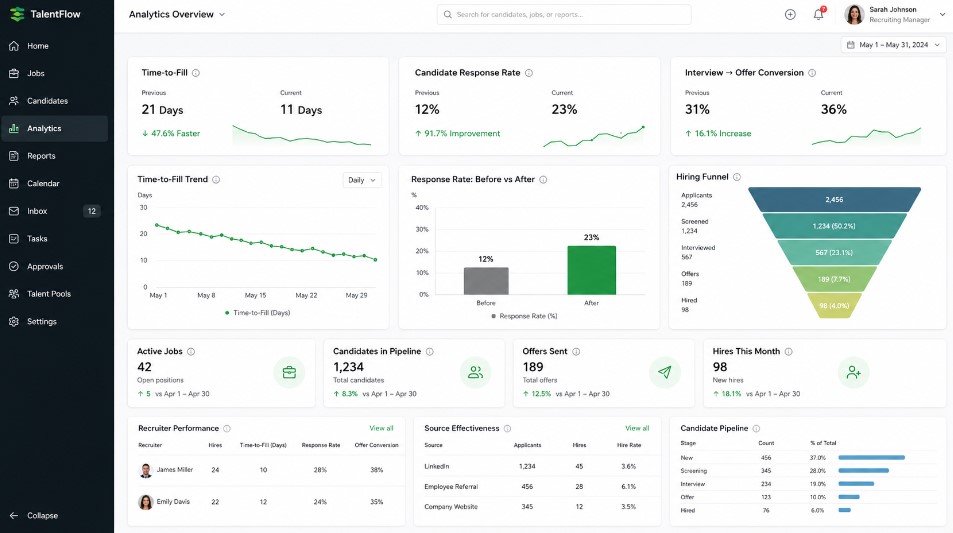
Before using structured prompts, our average time to fill a role was twenty one days. After implementing the refined prompt library, that number dropped to eleven days. That is roughly a forty eight percent reduction, which matches the promise in the title of this article almost exactly.
Candidate response rates to outreach messages increased from twelve percent to twenty three percent once we personalized prompts with role specific detail and company voice. Screening call scheduling, which used to take our coordinators nearly a full day of back and forth email, dropped to under two hours once we combined AI drafted scheduling messages with calendar integration.
“The testing process here mirrors what I did with 50 customer support prompts almost exactly.”
Interview to offer conversion also improved slightly, from thirty one percent to thirty six percent, which I believe happened because AI assisted interview guides kept our hiring managers more consistent and focused during evaluations.
What If Every HR Manager Tracked Their Prompts Like This
I keep asking myself this question : What if every HR manager treated artificial intelligence prompts the way marketers treat advertising campaigns, with real tracking, testing , and optimization instead of just guessing? I think the human resources field is still years behind departments when it comes to measuring the return on investment of artificial intelligence . This gap is an opportunity for anyone who is willing to build the habit of doing things differently early on. The human resources field and artificial intelligence can really work well together if people take the time to track, test , and optimize artificial intelligence prompts.
“I compared ChatGPT, Claude, and Gemini directly worth a look before you commit to one tool for recruiting.”
How to Build Your Own Recruitment Prompts for HR Managers
If you want to replicate what worked for us, start small and stay disciplined.
Begin by writing down the five tasks you do over and over. These could be things like writing job descriptions, scheduling interviews or summarizing performance reviews.
- Write a prompt for each task.
- Test the prompt with a task you have to do not just an example.
- Track how long each task takes before and after using AI help.
- Write down the time it takes every time even if it feels like a hassle.
For example lets say one of your tasks is writing job descriptions.
- Your first draft prompt might be:
- “Write a job description, for a software engineer.”
- Then you test it with a job description you need to write.
- You note that it took you 2 hours to write the job description before using AI help.
- After using AI help it took you 30 minutes.
- You write down these numbers:
- Before: 2 hours
- After: 30 minutes
- You do this for all five tasks.
- This will help you see how AI assistance is helping you.
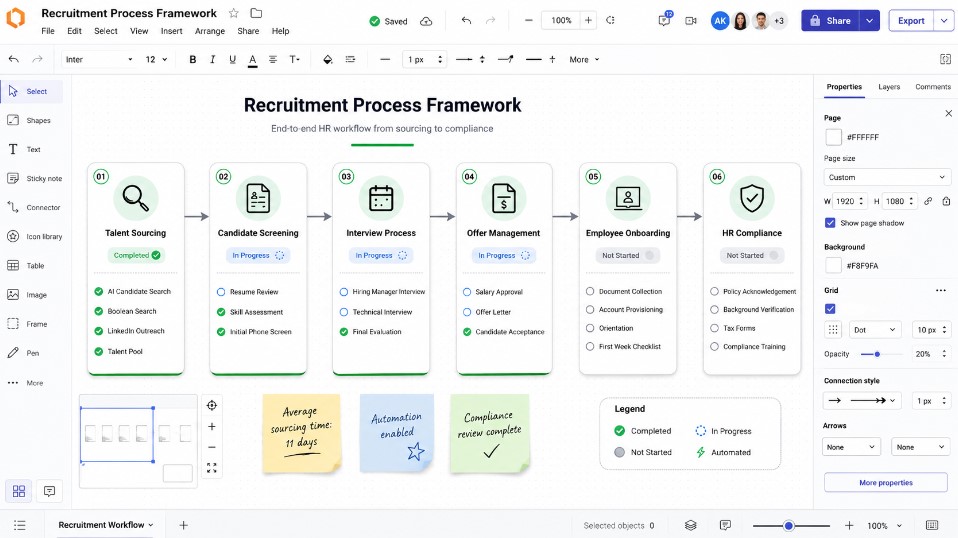
Review your results every two weeks. Refine the prompts that do not perform well. Eliminate anything that consistently gives you unusable output. As time goes on, you will create a library that reflects your company , meets your compliance requirements, and matches your actual hiring patterns instead of using a template you found on the internet. This library will truly represent your company’s voice and your hiring patterns. It will be based on your compliance requirements.
Final Thoughts From Someone Who Actually Tracked the Numbers
I did not write this article to convince you that AI will magically fix every hiring bottleneck. It will not. What I can tell you, based on real tracked data across forty tested prompts and a full quarter of use, is that a disciplined, measured set of recruitment prompts for HR managers genuinely cuts sourcing time, reduces administrative drag, and frees your team to focus on the human parts of the job that still matter most. Organizational Development, Employee Engagement, and honest human conversations cannot be automated, but the paperwork and repetitive drafting around them absolutely can.
Start tracking your own prompts this week. Pick one task, measure it honestly, and let the data tell you what is actually working in your agency.
FAQ’s
1. What are the best AI Prompts for HR Managers in 2026?
The best recruitment prompts for HR managers are specific, not generic. They include company context, role seniority, tone, and compliance requirements. Prompts built around Talent Acquisition, onboarding, and performance reviews tend to save the most time when refined through multiple test rounds.
2. Can AI really speed up recruitment and candidate sourcing?
Yes, when used correctly. In my own testing, structured AI prompts reduced average time to fill a role from 21 days to 11 days, mainly by speeding up Boolean search creation, outreach messaging, and interview scheduling.
3. Is it safe to use ChatGPT for HR tasks involving employee data?
Public AI tools should never receive sensitive candidate or employee data such as social security numbers or medical information. Secure, approved platforms connected to your HRIS should handle anything involving personal data to stay compliant with employment law.
4. Do AI prompts replace human judgment in hiring decisions?
No. AI can draft, summarize, and organize information, but final hiring decisions still require human judgment, especially for culture fit, employee relations sensitivity, and interpreting nonverbal interview cues.
5. How much can AI prompts realistically save an HR team in time?
Based on tracked data across 40 tested prompts over 12 weeks, our team saved close to 50 percent of total sourcing time. Results vary by company size, role complexity, and how well the prompts are refined over time.

Rehan is an Artificial Intelligence Specialist with 4 years of real world experience designing, fine-tuning, and implementing machine learning and LLM workflows. He founded PromptByJob to give professionals free, tested, and job specific AI prompts built from firsthand experience of how AI models actually think and deliver results.