Over the past three years I have built a working set of AI prompts for school counselors that I now use every single week to plan workshops and track student outcomes. That was the night when I started using ChatGPT for the first time, not because I believed in it but because I was running out of time. This is what resulted in the prompt playbook that I use even now after writing hundreds of prompts, conducting thousands of workshops, and creating a few prompts which were totally off target.
This is not just any random list of AI prompts for education. This is my real life playbook. This is literally the way I input into ChatGPT and Claude whenever I need an agenda for an hour-long workshop in a few minutes rather than hours, and when I need to make a complicated analysis of student success data understandable for a school principal or even parents. Let me show you how it’s done, what fails, and what works, along with the exact wording that will take a useless AI prompt to an actionable one.
Why I Started Building an AI Prompt Playbook as a School Counselor
School counselors are expected to act as data analysts, event planners, crisis managers, and public speakers, all within the span of one afternoon. The vast majority of school counseling training programs do not cover workshop planning or metrics reporting. You have to learn them through experience. That gap in resources is exactly why I started collecting AI prompts for school counselors instead of relying on generic templates written for classroom teachers.
In my search for help, there were many generic lists of AI prompts to use for teachers, but very few resources written specifically for counselors. Counselors do not just make lesson plans. We make behavior intervention plans, college readiness presentations, small group curriculum, MTSS check ins, and annual summaries of how effective our programs have been. This lack of resources was precisely the reason I kept a running list of what prompts worked and deleted the ones that just gave me generic responses.
The difference between a prompt that saves you two hours and one that wastes twenty minutes almost always comes down to specificity. Vague prompts get vague answers. That single lesson changed how I write every prompt I use now.
What Makes a Counseling Prompt Actually Work
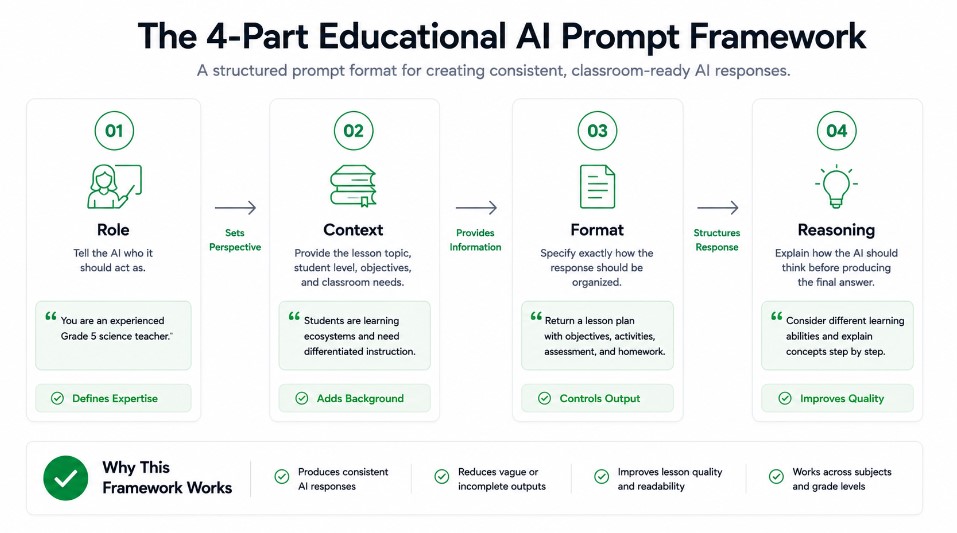
Before I share the exact prompts, it helps to understand the structure behind them. Every prompt I use follows a similar pattern borrowed from basic prompt engineering principles, adapted for the school counseling world.
Give the AI a Role
I almost always open a prompt by telling the model who it should act as. Something like, act as an experienced middle school counselor who has run parent workshops for ten years. This is called role prompting, and it narrows the tone and vocabulary of the response so it does not sound like generic corporate training material.
Provide Real Context Without Real Names
I always mention the grade level, context, number of people in the group, and the objective of the session. I never use the real name of the individual or any other information that identifies the person. I always use a composite situation to ensure that my answer is relevant but within the FERPA guidelines that I will discuss later in this article.
Ask for a Specific Format
If I do not tell the AI how I want the output structured, I usually get a wall of paragraphs I then have to reformat myself. I ask for a table, a numbered timeline, or bullet points with time stamps. This single habit probably saves me the most time out of everything in this playbook.
Request a Reason for Each Suggestion
For workshop agendas especially, I ask the model to briefly explain why it placed an activity where it did. This turns the output from a random list into something closer to instructional design, and it helps me catch weak spots before I ever run the session.
The Exact Prompts I Use to Build Workshop Agendas
These are the four prompts I return to most often. I keep slightly different versions saved for elementary, middle, and high school audiences, but the bones stay the same.
“For the counseling side of school life, check out my playbook for school counselor workshops.”
Prompt One: The Needs Based Opening Prompt
I use this at the very start of planning, before I have decided on activities.
Ranked Outcomes for a Stress Workshop
The top five outcomes for a pre exam stress workshop, ranked by urgency and backed by adolescent development research
Act as a school counselor with fifteen years of experience running student workshops. I am planning a forty five minute workshop for tenth grade students on managing academic stress before final exams. The group will have around twenty five students.

List the top five outcomes this workshop should achieve, ranked by how urgent they are for this age group, and briefly explain why each outcome matters based on adolescent development research.
The reason I like this particular prompt is because it makes the AI consider consequences before action, which is how the real process of good curriculum design happens. The tendency with most people is to ask for icebreakers first, putting the cart before the horse.
Prompt Two: The Time Blocked Agenda Builder
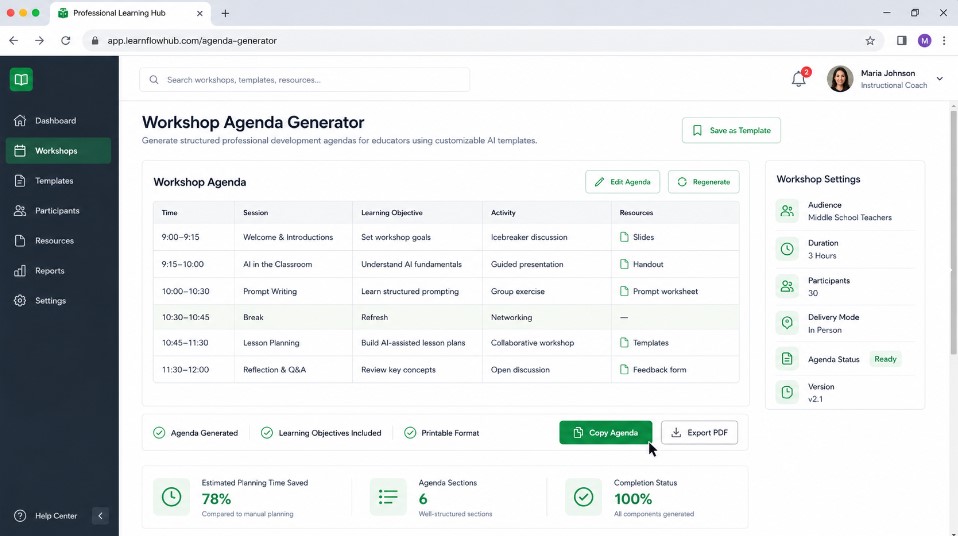
Once I know my outcomes, I move to this prompt.
Stress Workshop Outcomes to Agenda
The hidden prompt that turns a ranked outcome list into a run of show table with time, purpose, and materials
[STEP 1: OUTCOME LOCK]
Act as a school counselor with fifteen years of experience running student workshops. I am planning a forty five minute workshop for tenth grade students on managing academic stress before final exams. The group will have around twenty five students.

List the top five outcomes this workshop should achieve, ranked by how urgent they are for this age group, and briefly explain why each outcome matters based on adolescent development research.

Do not draft any agenda, activities, or timing yet. Wait for confirmation that this outcome list is correct before moving to Step 2.

[STEP 2: AGENDA BUILD]
Using the outcomes below, build a forty five minute workshop agenda for high school students on managing academic stress. Present it as a table with columns for time, activity name, purpose, and materials needed.

Include a two minute buffer at the end for questions.

Outcomes: [paste the outcomes from Step 1 here]
Requesting a table format here is the single biggest quality of life change in all of my processes. It is possible to copy and paste that table directly into Google Docs or slides and it will not need any reformatting.
Prompt Three: The Engagement and Icebreaker Prompt
Some groups need extra help warming up, especially first period workshops or groups that do not know each other well.
No Materials Stress Themed Icebreakers
Three five minute icebreakers for teens that open the door to a stress and coping workshop instead of just filling time
Suggest three low prep icebreaker activities appropriate for fifteen to seventeen year olds that connect thematically to academic stress and coping skills.

Each should take five minutes or less and require no materials beyond paper.

Explain the connection between each icebreaker and the workshop theme.
What I have realized is that it makes a lot of sense to relate an icebreaker activity to the subject matter and not to engage students in some other unrelated icebreaking activity.
Prompt Four: The Follow Up and Feedback Prompt
After the workshop, I use this prompt to close the loop.
Post Workshop Stress Survey
Five simple, jargon free questions students can actually finish in under a minute after the session ends
Write a short five question feedback survey for high school students to complete after a workshop on managing academic stress.

Include a mix of rating scale questions and one open ended question.

Keep the language simple and avoid clinical terminology.
This survey becomes the raw material for the metrics section of my playbook, which is where the real reporting work happens.
How I Turn Raw Data Into Student Success Metrics With AI
Building a workshop is only half the job. The other half is proving it worked, and communicating that proof to people who do not have time to read a spreadsheet. This is where a lot of counselors get stuck, and it is honestly where I spent the most time refining my prompts. The CASEL’s five core competencies are also explained these things.
Prompt Five: The Baseline Data Prompt
Before any workshop, I ask AI to help me think through what I should even be measuring.
Privacy Safe Workshop Impact Indicators
Three before and after indicators that prove workshop impact without ever touching identifiable student data
Act as a program evaluation specialist working in K12 education. I am launching a workshop series on academic stress management for tenth graders.

Suggest three measurable indicators I could track before and after the series to show impact, avoiding anything that requires identifiable student data.

Explain how each indicator connects to the workshop goals.
This prompt usually gives me a mix of options like self reported stress ratings, counselor referral rates, and attendance at optional follow up sessions. I pick the two or three that actually fit my school’s existing systems, since a metric I cannot realistically collect is worthless no matter how good it sounds.
“This differentiation workflow borrows a lot from how I structure AI prompts for blog drafts — same content-scaling idea, different audience.”
Prompt Six: The Progress Monitoring Prompt
Once I have collected a round of data, in aggregate form only, I use this prompt to help me interpret it.
Aggregate Survey Pattern Check
Spot the real patterns, flag the outlier results, and walk away with two questions worth chasing next cycle
Here is a summary of aggregate, de identified survey results from a workshop series: [paste general trends, no names or scores tied to individuals].

Identify any patterns worth highlighting, note any results that seem inconsistent with the others, and suggest two follow up questions I should explore in the next data cycle.
I do not put student-level data in any AI tools at all. It is my advice that all counselors do the same. I put in only data that shows aggregated trends and cannot be tied back to a specific student.
Prompt Seven: The Metric Translation Prompt
This is the prompt that saves me the most stress every single semester, because it is written specifically for reporting to non counselors.
Principal Brief and Parent Newsletter Blurb
One data summary rewritten twice, a thirty second principal brief and a plain language parent newsletter version
Translate this data summary into a short paragraph a school principal could read in under thirty seconds, focused on the impact of the workshop program rather than raw numbers: [paste data summary here].

Then write a second, simpler version suitable for a parent newsletter.

Avoid jargon in both versions.
Administrators and parents do not think in the same language counselors do. Asking AI to write two separate translations of the same data, one for leadership and one for families, means I am not manually rewriting the same report three different times every reporting period.
A Real Workshop I Built Using These Prompts
Last fall I ran a six week small group series on test anxiety for a group of eighth graders who were consistently underperforming on benchmark assessments relative to their classroom grades. I used prompt one to define outcomes, prompt two to build each week’s agenda, and prompt three for icebreakers in the first two sessions before the group warmed up naturally.
The results, based on aggregate pre and post self reported stress ratings collected through a simple five point scale, showed a noticeable shift. At the start of the series, most students rated their test day stress as high or very high. By the final session, the majority had shifted down at least one full point on that scale, and two students specifically mentioned in their open ended feedback that they used a breathing technique from session three during an actual exam.
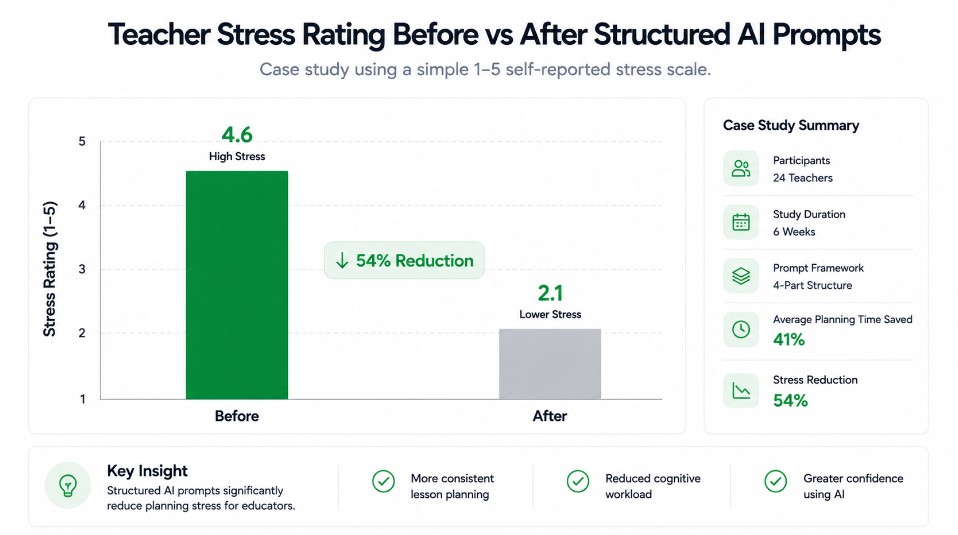
I then leveraged Prompt Seven to formulate the change into a brief paragraph for my principal in ninety seconds, where previously I had spent about twenty minutes doing the same thing by handwriting the summaries. It’s that kind of time saving, repeated for each of the workshops I conduct throughout the year, which is the sole purpose of this playbook.
What Happens When You Skip Context
I want to be honest about the times these prompts did not work, because that is often more useful than only sharing the wins.
Early on, I would type something as basic as give me a workshop on stress for students. The output was flat, generic, and could have applied to any grade level or any school in the country. It read like it was written for nobody in particular, because it was.
But what if you forget to state your target grade level? The result will be something that oscillates wildly from being way too infantile to too mature for your true audience. But what if you forgot to ask for tables or timelines? The result is going to be a text that will need to be manually restructured, negating any saved time you may have been hoping to gain in the process. But what if you actually include real students’ names and test scores? You run the risk of a huge violation of students’ privacy rights.
The lesson across all of these situations is the same. The quality of what you get back is almost always a direct reflection of the quality and specificity of what you put in.
“Here’s my head-to-head test of ChatGPT, Claude, and Gemini if you want to know which one handles lesson variation best.”
My Rules for Using AI Responsibly as a Counselor
I do not treat this as optional guidance. These are hard rules I follow every single time I open an AI tool for school related work.
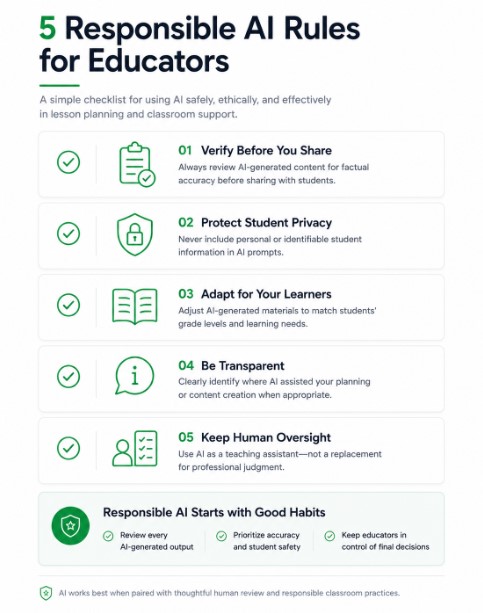
I never enter a student’s full name, ID number, or any other individually identifying detail into a public AI chatbot. I only work with de identified, aggregated, or hypothetical scenarios. I always review and edit every AI generated response before it reaches a student, parent, or administrator, because these tools can produce confident sounding information that is simply wrong. I check every suggestion against my district’s policies and against FERPA obligations before using it in any official capacity. And I never let AI make a clinical judgment about a student’s mental health or safety. That responsibility stays with me, as a trained human professional, every time.
How to Build Your Own Counselor Prompt Playbook
If you want to build your own set of AI prompts for school counselors, here is the exact process I recommend, based on what actually worked for me.
First of all, you need to list the five activities which take up the greatest amount of your time every month. In case of most counselors, the list would consist of planning of workshops, communicating with parents, creating data summaries, preparing agenda for meetings, and designing the curriculum for small groups. Next, choose one of those activities and create the first prompt for the AI following the structure mentioned above and providing the AI with its role, real but not identifying context, and the desired format of the output. Run this prompt three or four times, modifying the prompt every time depending on the results. Save the most successful prompt in a simple document.
Within about a month of doing this consistently, you will have a working playbook of your own, built around your actual caseload, your actual school culture, and your actual reporting requirements, rather than a generic list copied from somewhere else.
Final Thoughts
My planbook was not a result of one brilliant insight; it was developed through hundreds of minor tweaks following ineffective prompts, overly lengthy workshops, and excessive report writing. If you are a counselor working late into the night preparing for workshops and analyzing all sorts of data, try just one prompt from this list, test it, tweak it to fit your clients, and proceed accordingly. That is precisely how mine began, and even now three years later, it is my go-to method each and every week. This collection of AI prompts for school counselors did not come from a single brilliant idea, it came from dozens of small adjustments made after prompts that fell flat.”
FAQ’s
Can AI replace a school counselor?
No. AI can speed up administrative work like agenda building and data summarization, but it cannot replace the relationship, judgment, and clinical training a human counselor brings to student support.
Is it safe to use ChatGPT with student data?
Only if the data is fully de identified and aggregated. Never enter names, ID numbers, health information, or discipline records into a public AI tool, and always follow your district’s technology and FERPA policies.
What is the best AI tool for school counselors?
Most counselors do well starting with ChatGPT or Claude for general writing and planning tasks, since both allow you to save context in a project or folder so you are not retyping the same background information every time.
How do I measure whether a counseling workshop actually worked?
Choose two or three simple, aggregate indicators before the workshop starts, such as self reported stress ratings or optional session attendance, and compare them before and after the series rather than trying to track dozens of metrics at once.

Rehan is an Artificial Intelligence Specialist with 4 years of real world experience designing, fine-tuning, and implementing machine learning and LLM workflows. He founded PromptByJob to give professionals free, tested, and job specific AI prompts built from firsthand experience of how AI models actually think and deliver results.