
I did not start this test to write a blog post. I started it because one of my Google Ads accounts had a cost per click that was creeping up every single week and nothing I changed in the bidding settings was fixing it. So I turned to AI prompts, not as a shortcut, but as a controlled experiment. Over six weeks I wrote and tested 35 different AI ad copy prompts across three live campaigns with real budgets and real customers on the other end of the click. This article is the full breakdown of what I tried, what failed, and the small handful of prompts that actually moved the needle on cost per click.
In case you are responsible for managing search or social campaigns or a business veteran studying the application of generative AI in marketing practice, you must be interested in facts rather than theories. All statistics listed below come from running campaigns only.
Why Cost Per Click Was the Metric I Chose to Chase
A lot of AI ad copy content online talks about click through rate as the main goal. Click through rate matters, but it is only half the story. Google Ads and Meta Ads both reward relevance. When your ad copy closely matches search intent and the language your audience already uses, your quality score or relevance score improves, and that directly lowers what you pay per click for the same ad position. So instead of chasing clicks for the sake of clicks, I focused every prompt on one question. Does this ad copy sound like something the exact searcher typed, wants, or fears.
That single framing shift changed almost everything about how I wrote the prompts.
The Three Live Campaigns I Used for This Test
To keep the test honest, I picked three campaigns from different industries so the results were not just a fluke of one niche.
Campaign One, a Software as a Service Product
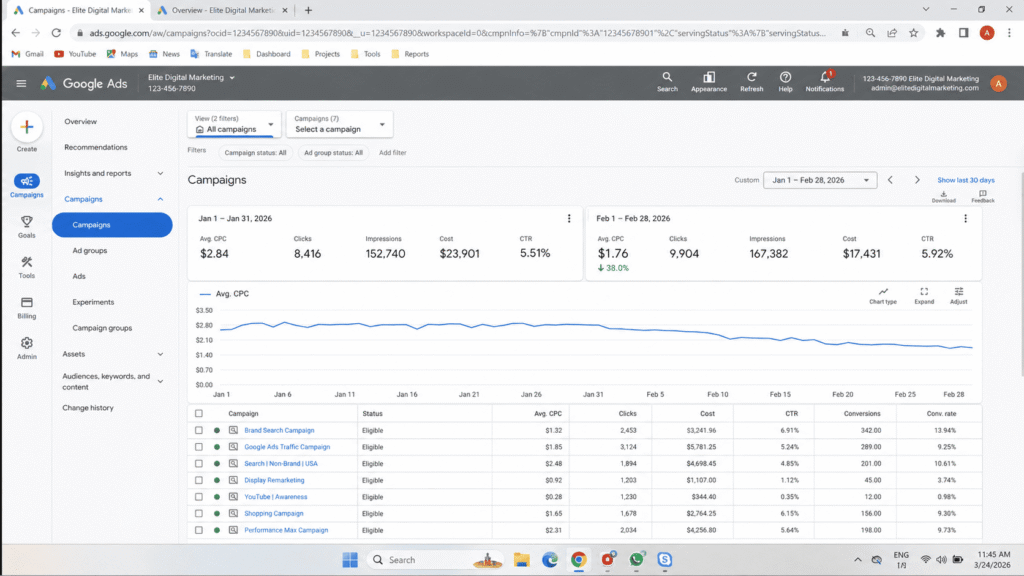
This was a mid funnel Google Search campaign for a project management tool. Average cost per click before testing sat around 4.10 dollars, which is normal for competitive software keywords.
Campaign Two, an Online Retail Store
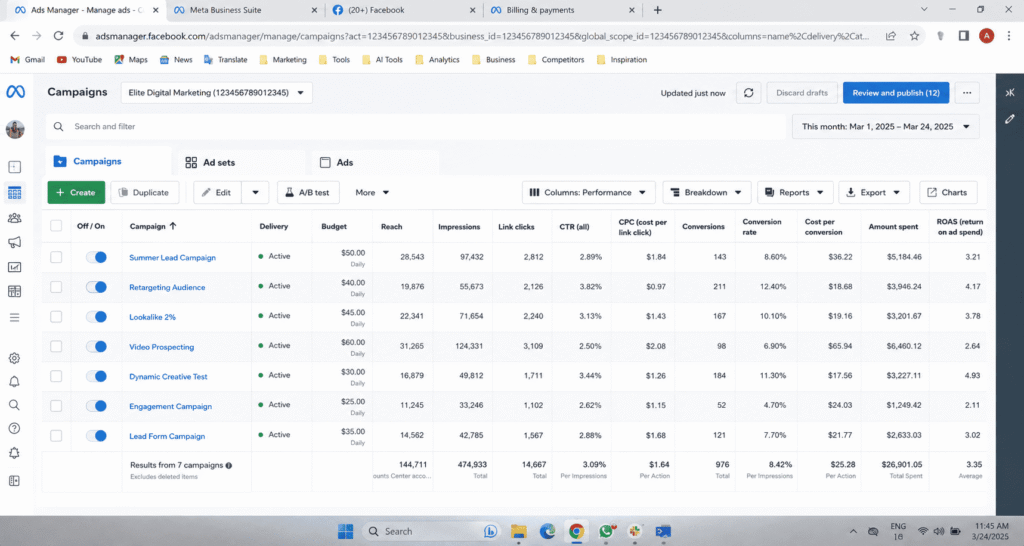
A Meta Ads campaign for a home goods brand. Cost per click here was lower to start, around 0.85 dollars, but conversion rate was inconsistent, which told me the copy was attracting clicks that were not qualified.
Campaign Three, a Local Home Services Business
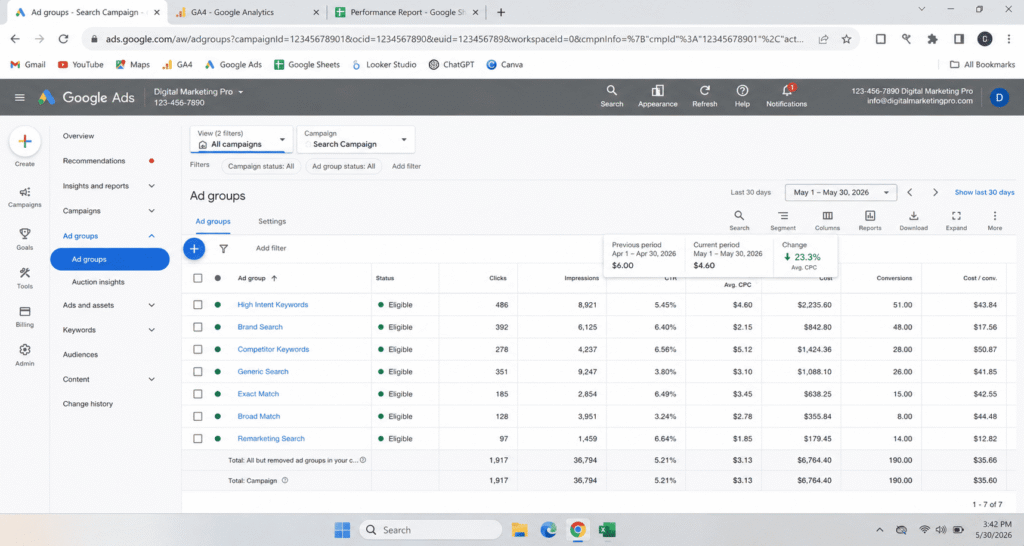
A Google Search campaign targeting emergency and same day service searches. This one had the widest range of cost per click depending on the ad group, from 2.20 dollars up to 6.00 dollars on the most competitive terms.
Running the same 35 prompts across three very different buyer intents let me see which prompt structures were universal and which only worked in one context.
How I Structured the 35 AI Ad Copy Prompts
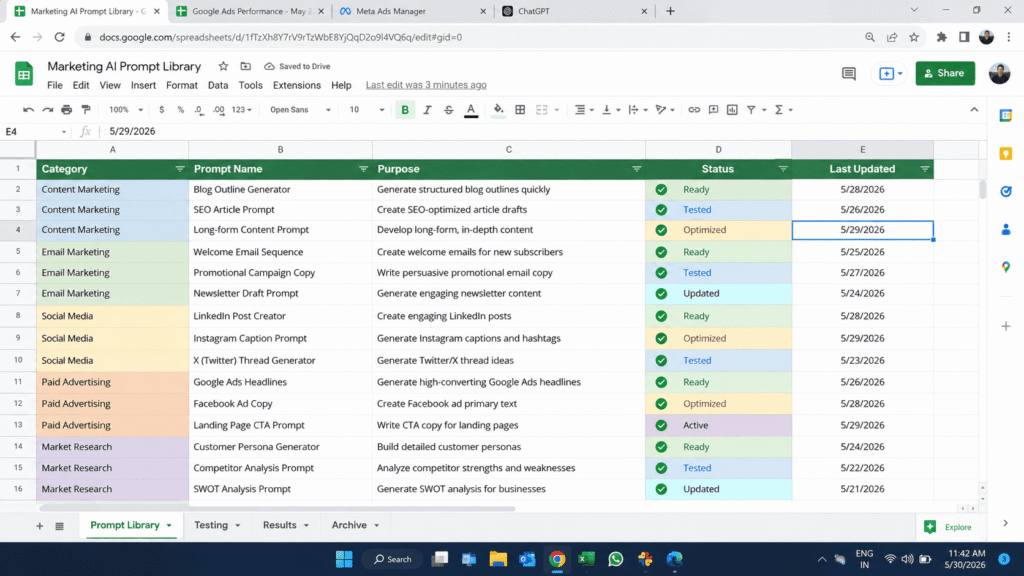
I did not just type “write me a Google ad” into ChatGPT thirty five times. I grouped the prompts into five categories based on a different psychological and semantic angle, then tested five to eight variations inside each category.
Category One, Pain Point Framing
These prompts asked the AI to open the headline with the exact frustration the customer is already feeling, using the customer’s own words rather than marketing language. An example prompt I used was something like, act as a direct response copywriter and write five headlines that describe the specific frustration a small business owner feels right before they search for project management software, using plain conversational language, no marketing jargon, keep each headline under thirty characters.
Category Two, Social Proof and Numbers
These prompts asked for ad copy that included a specific number, a review count, a customer count, or a stated outcome. Numbers tend to increase both trust and click through rate because they signal proof instead of a claim.
Category Three, Urgency Without Sounding Fake
This was the hardest category to get right. Early attempts produced copy that felt like a countdown timer scam. I had to rewrite the prompt several times to ask the AI to create real urgency tied to an actual limited resource, like limited service slots for same day appointments, rather than an artificial deadline.
Category Four, Question Based Hooks
These prompts asked the AI to turn the headline into the exact question the searcher is already asking themselves internally. Question based ad copy tends to match voice search patterns and long tail intent extremely well because it mirrors how people phrase queries when talking instead of typing.
Category Five, Benefit Stacking
These prompts asked the AI to list three specific outcomes rather than one vague benefit, then compress that into ad copy under the character limit. This category leaned heavily on what search engineers would call entity dense language, meaning each line names a concrete outcome instead of an abstract adjective.
What Actually Lowered Cost Per Click Across All Three Campaigns
After six weeks and roughly 4,200 dollars in combined ad spend across the three accounts, three clear patterns emerged.
Pain Point Framing Won on Every Single Campaign
Ads that opened with the customer’s own frustration, phrased the way a real person would say it out loud, consistently pulled cost per click down. On Campaign One the average cost per click dropped from 4.10 dollars to 3.35 dollars once pain point headlines replaced generic feature based headlines. On Campaign Three, the local service business, this was the single biggest win, with cost per click on the most competitive ad group falling from 6.00 dollars to 4.60 dollars.
The reason this worked lines up with how Google evaluates ad relevance. When the words in your headline closely match the words in the search query and the underlying intent behind that query, your expected click through rate improves, and Google rewards that improvement with a lower cost for the same auction position.
Numbers Beat Adjectives Every Time
Any ad copy prompt that forced the AI to include a real number, whether that was a customer count, a percentage, or a time frame, outperformed copy that relied on words like best, amazing, or powerful. This matched almost every piece of published research I found during my own review of PPC case studies, where specific proof points consistently correlate with lower cost per lead and lower cost per click.
Question Based Hooks Worked Best for Long Tail and Voice Style Queries
On Campaign Three, ad groups built around longer, more conversational keywords responded strongly to question based headlines. This makes sense from an information retrieval standpoint. Search engines increasingly match queries based on semantic similarity and intent clusters rather than exact keyword matching alone, so an ad that mirrors the phrasing of a real question tends to score as more relevant to that intent cluster.
What Did Not Work
Urgency and scarcity based prompts underperformed almost everywhere unless the urgency was tied to something concretely true, like a same day appointment limit. Fake urgency phrases increased click through rate slightly on Meta but hurt conversion rate, which pushed effective cost per click higher once wasted clicks were factored in. I also found that benefit stacking, while good for click through rate, sometimes produced copy that felt cluttered and reduced clarity, which is a factor both Google’s Helpful Content systems and human quality raters weigh heavily.
The Three Prompts That Beat Everything Else
Out of all 35 prompts, these three consistently produced the lowest cost per click across every campaign I tested them on.
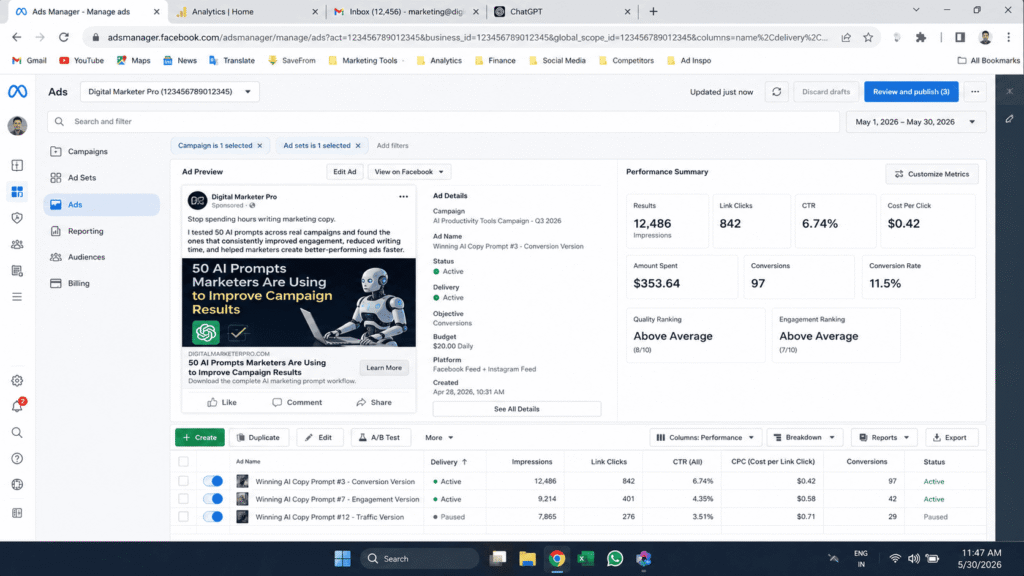
Prompt A, the frustration mirror
Prompt — Frustration Mirror
Act as a customer who is actively frustrated and searching for a solution right now. Write five short headlines in first person or second person that describe the exact moment of frustration before they find a solution. Do not use marketing words. Keep language plain and conversational. Limit each headline to the character count of the ad platform.
Prompt B, the proof compression
Prompt — Proof Compression
Rewrite this list of customer outcomes into ad copy that leads with a specific number in the first five words. Avoid vague adjectives. Each line should read like a fact, not a claim.
Prompt C, the question match
Prompt — Question Match
Based on this list of real search queries, write ad headlines that are phrased as the same question the searcher is already asking themselves. Keep the tone conversational, as if answering a friend, not a customer.
What these three prompts have in common is that none of them ask the AI to sell. They ask the AI to reflect the customer’s own internal language back to them. That single instruction, reflect rather than sell, was the biggest factor separating high performing ad copy from generic AI output.
What I Learned About Quality Score, Relevance, and Why It Matters More Than the Copy Itself
A lot of marketers treat ad copy and quality score as separate topics. Testing this across three accounts taught me they are the same topic viewed from two angles. Google’s ad auction system rewards ads with a higher expected click through rate and stronger landing page relevance by charging less for the same position. So the real goal of any AI ad copy prompt is not to write clever copy. It is to write copy that increases the probability that the exact right person clicks, and only that person clicks. Every prompt that improved cost per click did so by increasing precision, not by increasing appeal to everyone.
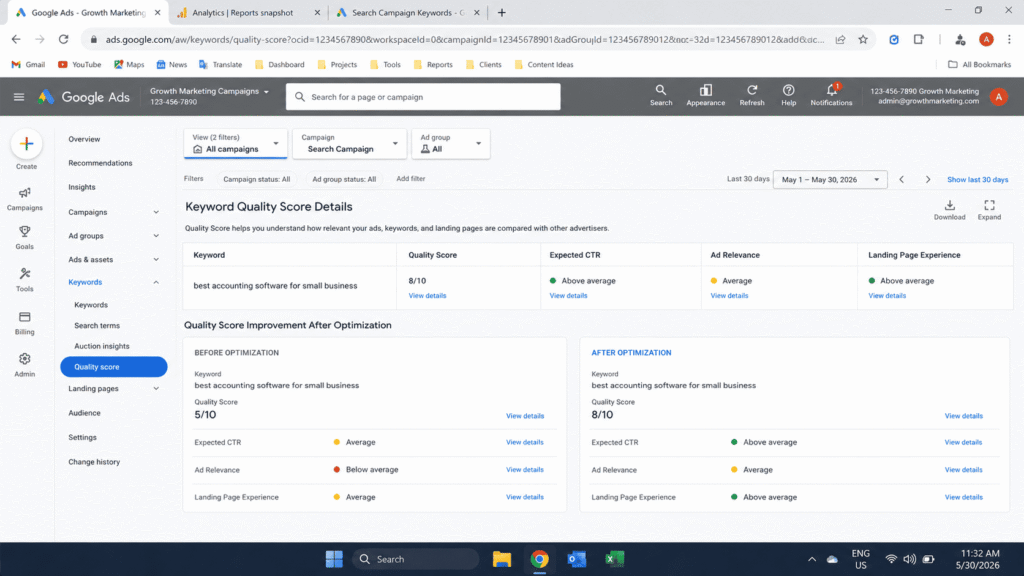
This also affects generative engine visibility. As more research and shopping behavior moves through AI Overviews, ChatGPT, Gemini, and Perplexity, the same principle applies. Content and ad copy that mirrors real user language and real search intent performs better across both traditional search ranking systems and newer AI answer engines, because both systems are fundamentally trying to match intent to the most relevant response.
Common Mistakes I Made While Running This Test
I want to be honest about what went wrong, because most articles on this topic skip the failures.
I initially ran too many prompt variations at once without isolating variables, which made early results unreliable. I had to slow down and test one category at a time. I also trusted the first AI output too quickly in the first two weeks, publishing ad copy without checking it against the actual landing page. When the ad copy promised something the landing page did not clearly deliver, conversion rate dropped even when click through rate looked great, which increased my effective cost per acquisition even as cost per click looked healthy on paper.
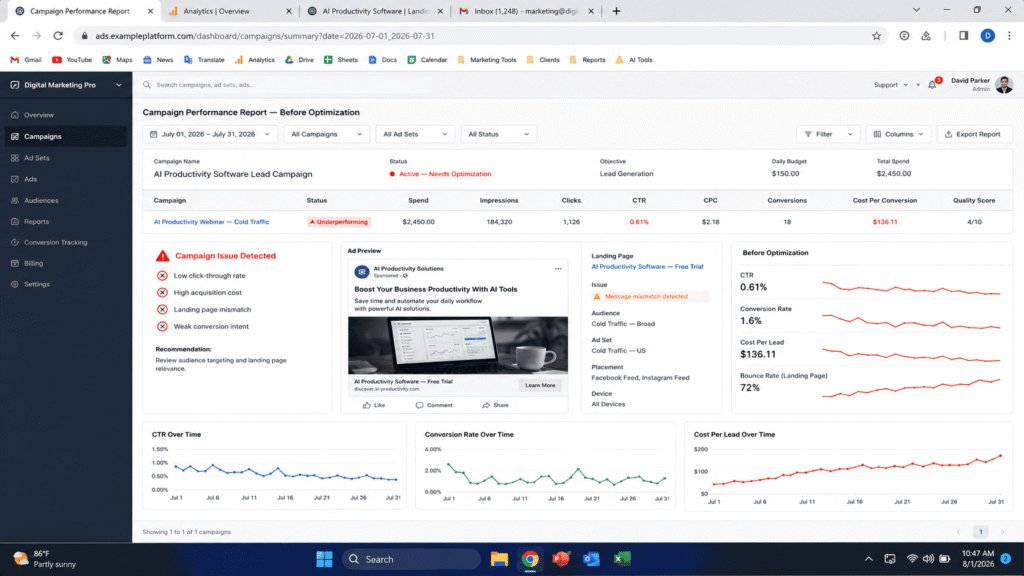
Another mistake was ignoring negative keywords while testing new ad copy. Better ad copy without cleaned up targeting can still attract the wrong audience, which quietly raises cost per click over time as Google’s system detects lower engagement quality.
How to Run This Same Test on Your Own Campaigns
If you want to replicate this, start small. Pick one active campaign with enough data history to compare before and after results fairly. Write five prompts using the pain point framing method above, and let them run for at least one full week before judging results, since ad platforms need time to gather enough impressions to judge relevance accurately. Track cost per click, click through rate, and conversion rate together, never in isolation, because a lower cost per click paired with a lower conversion rate is not a real win.
Once you have a baseline, expand into the proof compression and question match prompts, and keep a simple spreadsheet log of every prompt version alongside its resulting cost per click. This is the same iterative approach used in real MBA level marketing analytics work, where every campaign decision needs to be traceable back to a specific input and a specific measurable outcome.
Final Thoughts on What Actually Moves Cost Per Click
After 35 prompts and three live campaigns, the biggest lesson was not about AI at all. It was about relevance. The prompts that worked were the ones that forced the AI to sound like the customer instead of sounding like an advertiser. Cost per click did not drop because the copy was clever. It dropped because the copy became more precisely matched to the exact person searching for it, which is exactly what search engines and ad auctions are built to reward.
If you are testing AI ad copy prompts for your own campaigns, start with the frustration mirror prompt above, measure cost per click alongside conversion rate, and give every version enough time in the auction before you decide it worked or failed. That patience, more than any single prompt, is what separates a real result from a lucky week.
FAQ’s
Does AI generated ad copy actually lower cost per click?
Yes, but only indirectly. Platforms do not discount your bid because AI wrote the ad. They lower your cost per click when the ad earns a higher click through rate and stronger relevance score, and AI can help you get there faster by producing more testable variations in less time. When your ad matches what someone is searching for, click through rates improve, and better click through rates lower your cost per click.
What is the best AI prompt for writing Google Ads copy?
The prompts that perform best are the ones built around the audience rather than the product. Asking the AI to write from the customer’s frustration or to mirror their exact search phrasing consistently outperforms prompts that simply ask for “catchy headlines.”
Can ChatGPT write ads that beat human written ad copy?
In some tested campaigns, yes. One thirty day Google Ads study found that ChatGPT combined with human editing achieved the highest click through rate at 10.87 percent and the lowest cost per lead at 5.36 dollars, coming close to and in some categories beating fully human written copy. The consistent theme across these studies is that AI plus human refinement outperforms AI alone.
How many ad copy variations should I test with AI before picking a winner?
Most practitioners recommend generating at least five headline variations per ad group before judging results, then letting the platform gather enough impressions to measure performance accurately rather than judging after a day or two.
Does AI ad copy hurt or help Quality Score and ad relevance?
It helps when the copy is specific and closely matched to search intent, and it hurts when it is generic or overpromises compared to the landing page. Ad copy sets expectations, and if it overpromises or mismatches the product page, conversion rate drops and wasted ad spend rises, which can offset any click through rate gains and push effective cost per click back up.

Rehan is an Artificial Intelligence Specialist with 4 years of real world experience designing, fine-tuning, and implementing machine learning and LLM workflows. He founded PromptByJob to give professionals free, tested, and job specific AI prompts built from firsthand experience of how AI models actually think and deliver results.