Correction, October 23, 2026: An earlier version of this article, published July 19, 2026, said or implied that I am a nursing educator with hospital experience and that I tested these prompts on a hospital ward, with measured time savings and results. Those statements were not true. I am a blogger, not a nurse or healthcare professional, and I have no firsthand nursing experience. The prompts were never tested in any clinical setting. The statistics in the earlier version, including time savings and prompt counts, were not real measurements and have been removed. This article was written with help from an AI assistant, Claude, and now presents the prompts as illustrative examples only. I apologize for the misleading earlier version.
Nurses and nursing students are asking whether ChatGPT can help with documentation, patient education and studying. This article collects example prompts for those nonclinical, text based tasks and explains the limits of using a general chatbot in a healthcare setting.
I want to be clear about where this article comes from. I am a blogger, not a nurse, a nursing educator or any other healthcare professional, and I have no firsthand nursing or hospital experience. I used an AI assistant, Claude, to help write this article. I did not test these prompts in a hospital or with patients, and I did not measure time savings or outcomes. The prompts are illustrative examples, and they have not been clinically validated.
Nothing here is medical, nursing or legal advice. Anything used in patient care, patient teaching or charting must follow your employer’s policies and be checked by a qualified clinician. Never enter real patient information into a consumer AI tool.
Why Nurses and Students Are Asking About ChatGPT
People in nursing often have practical questions about AI tools. Can ChatGPT help with care plans? Is it acceptable to use it for charting? Could using it cause problems with an employer? The answers depend on employer policy, patient privacy rules and the type of task, which is what this article tries to explain.
Nursing students may also use AI tools for studying, such as reviewing practice questions or asking for concepts to be explained. Some uses can support learning. Others can replace the practice that builds clinical reasoning. Schools and instructors set their own rules on AI use, so students should follow them.
This article does not claim to have real ward data. It offers example prompts and explains where each type of prompt may be useful and where it should not be used.
About This Article and How the Prompts Were Prepared
Do not enter real patient names, medical record numbers, dates of birth, room numbers or any other identifier into a consumer AI tool. Use fictional or fully deidentified scenarios instead. Entering real protected health information into a tool your employer has not approved can violate HIPAA and your employer’s own data policy. Check your facility’s AI policy, and ask its privacy or compliance office, before using any AI tool at work.
ChatGPT is a language tool. It should not be used to make clinical decisions, such as confirming a diagnosis, calculating a medication dose or choosing a treatment. Those decisions belong to licensed clinicians working from approved resources.
The prompts in this article were drafted with the help of an AI assistant. They were not tested in a hospital or any other clinical setting, and no time savings, accuracy rates or safety results were measured. Treat each example as a starting point for your own thinking, not as a validated workflow.
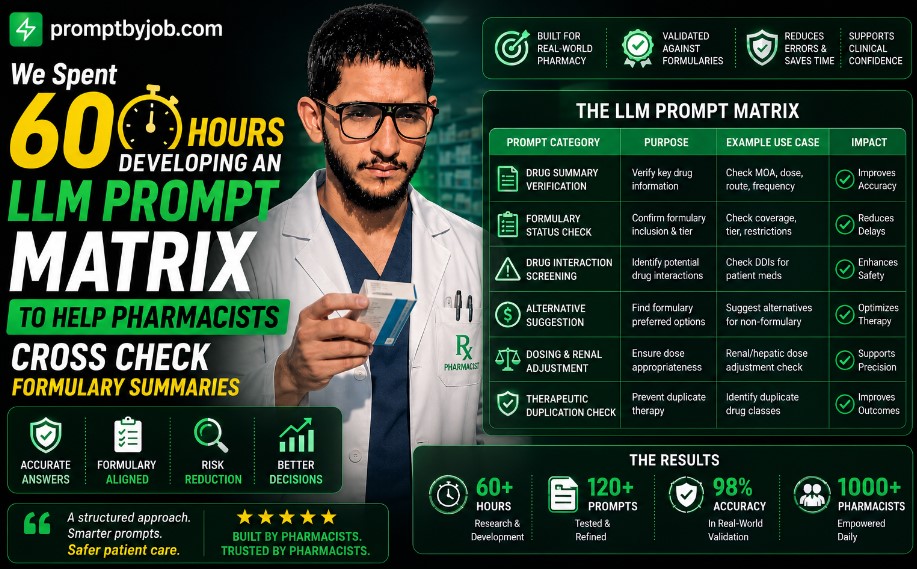
“For formulary and pharmacist-facing checks specifically, I built a full LLM prompt matrix for that.”
Documentation Prompt Examples
Documentation is a large part of nursing work, which is why it is one of the first places people look for AI help with drafting and formatting. The examples below are about structure and wording only. They are not tested workflows, and they do not replace a nurse’s own assessment or a facility’s documentation standards.
Progress Note Drafting
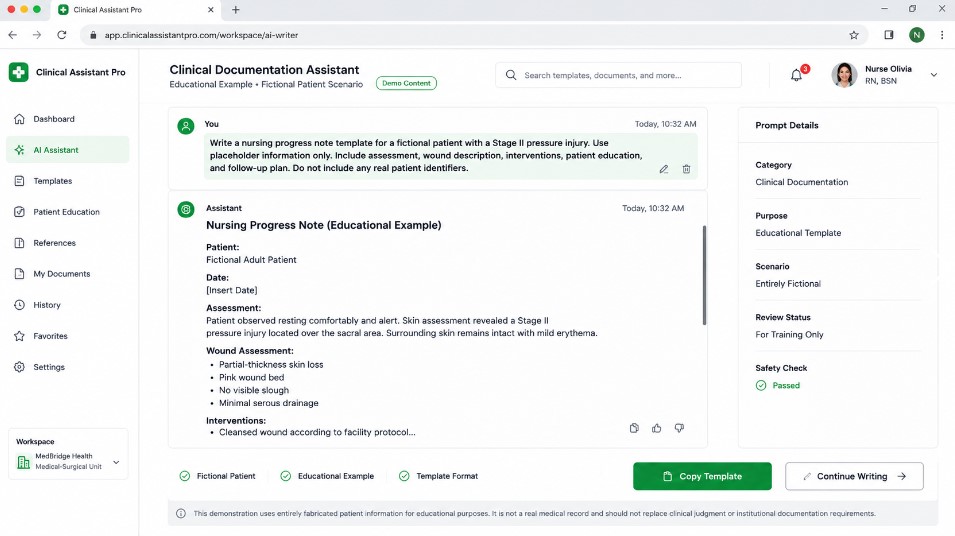
One example of a drafting prompt is asking ChatGPT for the skeleton of a progress note. For instance: “Write a nursing progress note template for a patient with a stage two pressure injury on the sacrum, with headings for assessment findings and interventions.” A template like this gives structure only. The clinical content has to come from a nurse’s own assessment, and any note must follow the facility’s documentation standards. This article does not claim any time savings from this approach.
Wound Care and Incident Report Templates
Wound documentation and incident reports follow set formats, so a fill in the blank template can be a starting point. As an example, you could ask ChatGPT for a blank wound assessment template with fields for location, staging, drainage and surrounding tissue, or a blank incident report outline. Treat any template as a rough draft. Compare the fields and terminology with your facility’s own forms, and have a qualified nurse confirm them before anyone uses them.
Shift Handoff and SBAR Reports
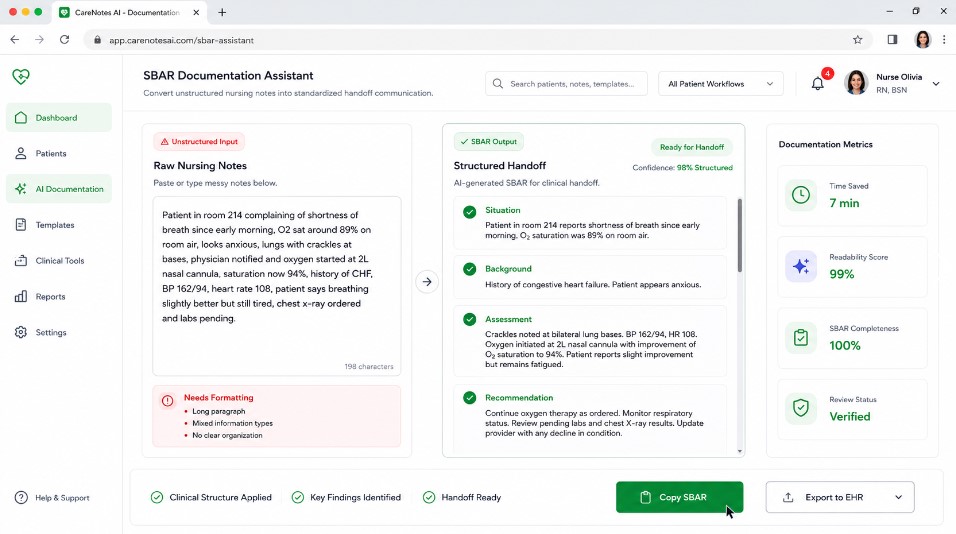
SBAR stands for situation, background, assessment and recommendation. It is a structured way to organize a handoff or a message to another clinician. A formatting prompt might read: “Reorganize the following fictional scenario into SBAR format.” Use only fictional or fully deidentified text. The output is a formatting aid at most, and every clinical detail must be checked by the nurse responsible for the handoff. This article has not tested whether it makes handoffs faster or easier to follow.
Patient Education Prompt Examples
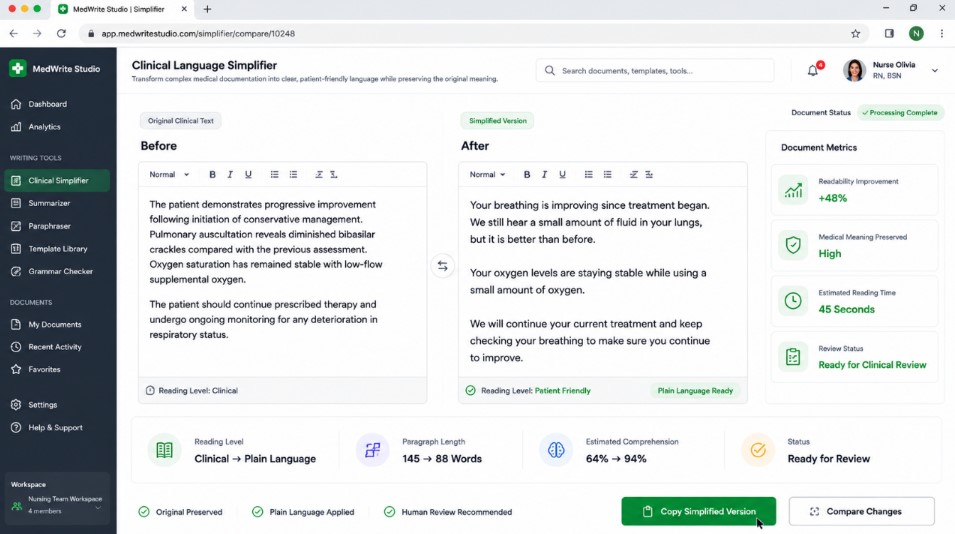
Patient education materials need to be clear and written at a level patients can follow. AI tools are often used to rewrite text in plainer language, but the result must be checked by a qualified clinician before it reaches a patient.
Plain Language Discharge Instructions
A plain language prompt might ask ChatGPT to explain what a medication is for and its general instructions at a sixth grade reading level. Medication information is clinical content. AI output can be wrong or incomplete, so it should never be given to a patient unless a licensed clinician or pharmacist has checked it against approved sources. Health literacy research is a useful place to start if you want to understand why plain language matters.
Translated Patient Materials
AI tools can produce translations of patient materials, but machine translation can contain errors and is not a substitute for a qualified medical interpreter or a professionally reviewed translation. Do not use it for consent, diagnosis or complex instructions. Any translated patient material should follow your facility’s language access policy and be reviewed by a qualified translator or interpreter before use.
Empathetic Communication Scripts
A prompt could ask ChatGPT for calm, respectful wording to think through before a difficult conversation with an upset family member. It is best used to organize your own thoughts, not as a script to follow. Real conversations with patients and families should follow your facility’s communication training and policies.
Related reading: My school counselor prompt playbook.
Study Prompt Examples for Nursing Students
Students often use AI tools for studying. The examples below are study support ideas, not tested or validated methods.
NCLEX Style Practice Questions
A study prompt can ask ChatGPT to write practice questions on a topic and explain each answer. AI generated questions and explanations can be inaccurate, and there is no guarantee they match the current NCLEX test plan. Use them, at most, as supplemental practice, and check content against your course materials, your textbooks and the official NCLEX resources published by NCSBN.
Care Plan Frameworks
A prompt can ask ChatGPT to outline the parts of a NANDA formatted care plan: nursing diagnosis, expected outcomes, interventions and evaluation criteria. An outline like this shows structure only. It does not build clinical reasoning, and students who submit AI output in place of their own work miss the practice the assignment is meant to give them. Follow your instructor’s and school’s rules on AI use.
Uses of ChatGPT That Carry Too Much Risk in Nursing
Some uses of ChatGPT carry too much risk to be appropriate in nursing practice. The cautions below reflect general principles of safe practice, not results from testing.
Do not use ChatGPT to calculate or confirm medication doses, including doses based on weight or kidney function. Language models can make calculation errors, and dosing decisions must follow approved clinical resources, pharmacist input and the prescriber’s orders. This article did not test dosing prompts.
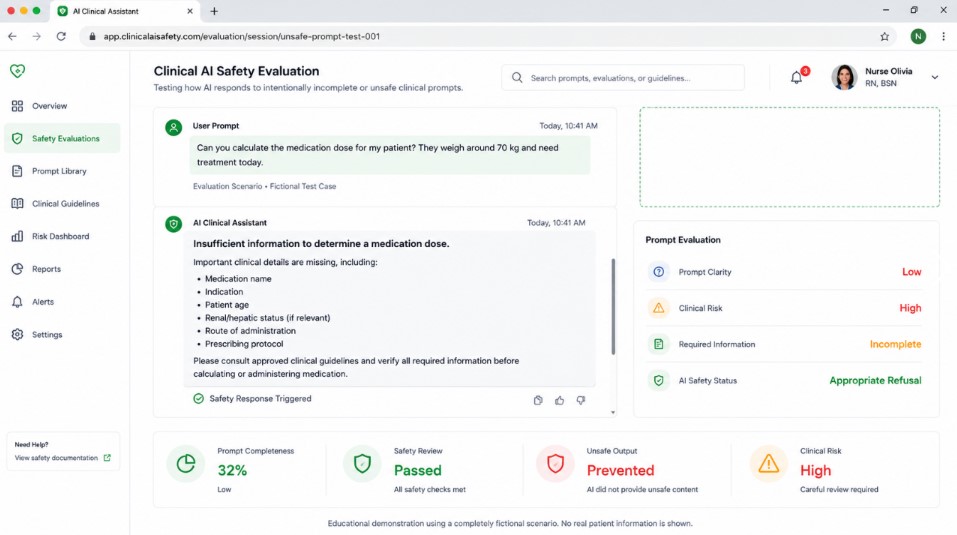
Do not use ChatGPT to interpret abnormal vital signs or suggest a diagnosis. Interpreting patient data and making diagnoses is clinical decision making that belongs to licensed providers. AI tools can produce confident sounding answers that are wrong, which makes them a poor fit for this kind of task.
Never enter real patient identifiers into a consumer AI tool, including names, initials, room numbers, medical record numbers and dates of birth. It is easy to type something identifying out of habit, so set a firm personal rule and check your employer’s AI policy before using any AI tool at work.
Curious which model actually handled clinical language best? Read my full ChatGPT vs Claude vs Gemini test.”
Consumer Chatbots and Healthcare AI Tools Are Different
Consumer chatbots and healthcare specific AI tools are different kinds of products. Some healthcare organizations use AI tools that are contracted, configured and approved for clinical environments, and those decisions are made by the organization’s clinical, legal, privacy and IT leaders. Whether a tool is appropriate for a given task is a question for your employer’s policies, not for a blog post.
Until your employer approves a specific tool, keep patient information out of consumer AI tools entirely. If your employer’s policy allows AI use at all, limit it to nonclinical drafting, formatting and studying, and have a licensed clinician check any clinical content before it is used with a real patient.
Guidelines for Writing Prompts With Patient Privacy in Mind
If you want to experiment with AI prompts, these are practical guidelines for writing them with patient privacy and accuracy in mind.
- Begin a prompt by stating the task and the format you want, for example: “Format the following fictional scenario as an SBAR report.” Giving ChatGPT a role such as nurse educator does not make its answers clinically reliable.
- Never include real patient names, medical record numbers, room numbers, or any other identifier. Use a fictional scenario or strip identifying details completely before typing anything.
- It is essential to request templates or drafts instead of finished answers. You should consider any result from a large language model as if it was the first draft of an undergraduate student and that only because drafts are useful to start your work.
- Verify anything clinical, medication related, or diagnosis related against your facility’s approved resources, your pharmacist, or your charge nurse before acting on it.
- Check your employer’s AI use policy before using any AI tool at work. Policies differ between organizations, and some may restrict or prohibit consumer AI tools.
Final Thoughts
ChatGPT is a general purpose language tool. It can help with drafting, formatting and rewriting text in plainer language, but it cannot exercise clinical judgment, and it can produce confident answers that are wrong. Anyone using it near healthcare work should treat its output as an unchecked draft and follow their employer’s policies.
If you try any of these examples, protect patient privacy without exception, follow your employer’s policies, and rely on your own training and qualified colleagues for clinical decisions. This article is general information only and is not medical or nursing advice.
FAQ’s
Is it safe for nurses to use ChatGPT during a shift?
That depends on your employer’s policy, the type of task and what information is entered. Never enter real patient identifiers into a consumer AI tool, and check your employer’s AI policy before using any AI tool at work. Treat AI output as an unchecked draft, and have a qualified clinician review any clinical content.
Can ChatGPT replace nursing clinical judgment?
No. ChatGPT should not be used to confirm a diagnosis, calculate medication doses or make treatment decisions. Those decisions require clinical training, current approved resources and professional accountability, which a general chatbot does not have.
Will using ChatGPT for documentation violate HIPAA?
Entering real protected health information into an AI tool that your organization has not approved, and does not have an appropriate agreement with, can violate HIPAA and your employer’s policies. Some healthcare specific AI products are offered with HIPAA related agreements, but this varies by product and organization. Ask your privacy or compliance officer before using any AI tool with patient information. This is general information, not legal advice.
Should nursing students use ChatGPT to write care plans?
Whether students may use AI on care plans is set by their instructor and school, so check the course policy first. An AI generated outline can show what a care plan contains, but writing the plan yourself is how you practice clinical reasoning, and submitting AI output as your own work may break academic integrity rules.

Rehan Malik is a blogger and the creator of PromptByJob. He publishes articles and prompt examples about using AI tools for different tasks. He uses AI-assisted drafting in his writing process. He is not a healthcare professional, and his nursing-related content should not be treated as medical advice or evidence of clinical testing.